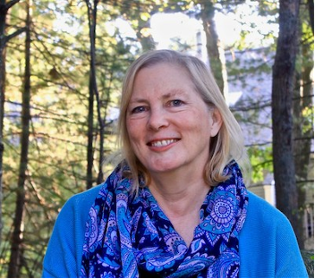
On Surviving a Lethal Diagnosis and Giving Back

By Steve Buechler

For most of my adult life, my identity was rooted in my role as a professional sociologist. In that capacity, I taught graduate and undergraduate courses on social theory, social inequality, social movements, and sex and gender. I also published seven books on women’s movements, social movement theory, and critical sociology.


All that came to an abrupt halt at age 64 when a routine physical exam led to a diagnosis of acute myeloid leukemia, widely considered the deadliest of the blood cancers. Without immediate treatment for AML, life expectancy is measured in days or weeks, months if you’re lucky. So within 48 hours, I went from feeling perfectly fine to intensive chemotherapy and a five week hospital stay.


This initial treatment achieved a temporary remission that bought me time to decide upon further treatment for a disease that always comes back. Three months later I received a double umbilical cord blood stem cell transplant, followed by six months of gradual and uneven recovery.


Nothing about it was easy, but I hit the treatment trifecta: early remission, full donor engraftment, and no graft-versus-host disease. This led my oncologist to call me a “statistical outlier,” but it was her sweet words that stuck with me as she pronounced “this is as good as it gets.” I’m now more than six years out from my transplant, cancer-free, and considered cured.


I was too busy with cancer to develop a retirement plan. But I have found a calling as a peer volunteer, patient advocate, and writing workshop instructor in the cancer community. This work is meant to honor those who saved me.


For most of my life, doctors didn’t take me seriously because I didn’t have anything serious to treat. Sprained ankles and sore throats were pretty mundane. Leukemia was different, and the medical care I received was simply superb. My doctors and nurses combined skill and expertise with compassion and empathy in ways I will never forget or could ever repay.


I would never call cancer a “gift” or an “opportunity.” But if surviving cancer doesn’t change you in some foundational way, then you really weren’t paying attention. The coping skills I developed throughout treatment continue to serve me well in many aspects of my life, and my odyssey has left me with profound gratitude, deep empathy, renewed resilience, and a rich appreciation for the simple pleasures of life.


A fuller version of my story may be found in my memoir How Steve Became Ralph: A Cancer/Stem Cell Odyssey (with Jokes)” and at www.stevebuechlerauthor.com.

Audio production by Alexandra Salmon


Music credits:


10 minutes Past by Blue Dot Sessions

Edoy by Praire

Amadines by Sergey Cheremisinov 

Garden Tiger by Pictures of the Floating World 

Healing My Broken Story: Rising from the Ashes

By Michael Robin

The narrative arc of my story is characterized by three acts but they are in reverse order – the ending, the transitional or healing stage, and new beginnings. My story begins with an abrupt ending to what had been the first sixty-three years of my life. 

On November 27, 2013, I made an attempt to end my life.  For five intense months prior, the thought of suicide held me captive. A series of traumatic life events were what drove me to suicide.  I had lost my job, income, and health insurance; I feared losing my professional therapy license and home; and my marriage was imploding. Isolated and cut off from the world, uncertain about who I was and why my life mattered, my ability to resist the temptation for oblivion faded rapidly.  I couldn’t, in the words of F. Scott Fitzgerald, “hold in balance the sense of futility of effort and the sense of the necessity to struggle.” 

Living through a suicide attempt is a unique kind of bereavement.  It was after my suicide attempt that I learned that the feeling of suicidal despair is impermanent.  The thought that my suffering would never end is what drove my suicidal behavior.  Suspended in time and social space, my death was spiritual, not corporeal. As my old self was dying, my new self was struggling to be born.  I identified with the writer Matthew Arnold who wrote, “I was wandering between two worlds, one dead/the other powerless to be born.” I had been in “limbo”, crossing an extended threshold, where I entered as one person and came out another.  My suicide attempt marked the turning point in my life. 

Recovering from a suicide attempt has not been simple or easy.  I’ve had no self-help formula to rely on, nor have I been offered “cheap grace.”  I write about the past to re-present my disparate emotions from a more enlightened present.  With the passage of time, my perspective has changed and evolved many times over. Remembering and revising my story gives significance to my life.   I no longer regret the past.  What happened, happened.  A life story can be revised, but not relived.

In my writing, I seek transcendence, a sense of insight and awareness about what is of ultimate significance.  As I do so, I encounter the sacred realm which is the transition point between endings and new beginnings.  It is as if my words are pulling me into new realms of existence.  I am writing myself out of the deep hole I once found myself in.  This is the spiritual power of transformative writing.  I found light by peering into the darkness. 

As a survivor of a suicide attempt, I feel responsible to share my story as a lived experience.  I write to offer a singular perspective on what it feels like to be suicidal, attempt suicide, survive, and be radically transformed by the experience.  While I am hardly the first person to attempt suicide, I have felt the uniqueness of my story.   I am one of the few writers on suicide who has been a seasoned therapist, teacher, author, and patient.  I write to comprehend the paradoxical richness of my story, the wisdom it has bequeathed to me, and the insights I might share with others. 

I write to describe my inner experience; what I feel now, what I felt then, and their interconnection.  In my writing, I seek transformation and transcendence, a sense of insight and awareness about what is of ultimate significance.  One of the striking things about writing is how it has changed me as a person.  Who I was is not who I am now, but I could not be who I am without writing about what I’ve been going through. 

Nine years ago, I was suffering from the ancient sin of acedia which the thirteenth century philosopher, St. Thomas Aquinas defined as a “loss of energy to begin new things.”  I felt like I was carrying the weight of the world on my shoulders.  In the depths of despair, I lacked perspective, unable to see the sacredness of life itself.  To move forward, I had to face my suicide attempt for what it was. 

At the time, I didn’t recognize my survival as the opportunity it was.  It felt inauspicious, unlikely to ever be seen as a blessing.  But as I leaned into the pain, I came to appreciate being a member of what Albert Schweitzer called the “brotherhood of those who bear the mark of pain.”  The more I befriended my pain, the less it burdened me.  My pain lessens when I am less afraid of it.  The more I accept it, the less it overwhelms me.

It has been my responsibility to play an active role in finding meaning to my suffering; to learn and grow from the experience.  This viewpoint has allowed me to grow into the person I am becoming.  I am grateful that God graced me with the wisdom and courage to persevere.  From Holocaust survivor, Elie Wiesel, I learned “to begin something new is a wonderous thing.  But to lose everything and be able to begin over again is nothing less than a miracle.”  For the first time in my life, I now fully appreciate the blessing of being alive.

It is only in hindsight, that I can see how transformational these losses have been.  I’ve looked to the spiritual traditions, not just social psychology, to guide me on my journey.  If I was to thrive and not merely survive, I had to walk down what Native Americans call the Red Road, a metaphoric symbol of healing and transformation.  It took many months for me to see my losses as harbingers of new beginnings. Converting memories of loss to memories of meaning has been my ongoing existential task.  While I’m a fairly stationary person, I’ve traveled many miles in my imagination.

My healing imagination resists the idea that I should not feel the pain of the past.  From the beginning, others wanted me to “be over” the pain without understanding that grieving is an ongoing and life-affirming process.  Grief is not a pathological process to be cured.  My quest has been to experience grief, not classify it.  In the process, I have a profound sense of gratitude for my continued life.  I don’t need to bring the nebulous concept of “closure” to my old life to feel fully alive today.

Imposing a semblance of meaning to what had once been so traumatizing, allows me to feel better, think more clearly, and function with more confidence.  Reducing the chatter in my brain has allowed me to be more discerning.  I have created a calming distance between my thoughts now, and what happened then.  Being mindful in the present does not mean I’m not affected by the past.  I still have anxiety but I no longer have the agitation that once overwhelmed me.  I no longer fear dying alone and unloved, because I am no longer alone and unloved.

Of this, I am sure.  If it was up to me, I would plead for eternal life in this world.  I don’t want to die but when I do, I want my life to be well-lived.  I need to feel that my life has mattered, that in my small way, I have contributed something of value to the human experience.  I want my writing to be an important part of my spiritual legacy.

Much of the value of writing about trauma is in how words are received.  I have found power, a sense of personal efficacy when my words influence and inspire others.  The most common response to my writing has been, “Wow Michael, this is going to help a lot of people when it is published.” Writing has helped me understand my experience by using transformative language that helps reshape my sense of self and relationships with others.

As I pass through the seasons of my life, I appreciate the wisdom of singer Joni Mitchell who wrote, “Something’s lost, but something’s gained, in living every day.”  It’s been said that you cannot have a testimony without a test.  I had to go through a cleansing fire to rise from the ashes.  For the first time in my life, I am truly happy to be alive.  Living a life of meaning has been the guiding light that illuminates my path forward, allowing me to see beyond myself.  My highest aspiration is when I die, my friends and loved one’s will say a hearty and eternal “Amen.”

Read part two: On Living with Parkinson’s Disease


  Michael Robin is a clinical social worker with more than forty years of experience.

Health Story Collaborative
Fall 2022 Newsletter

Check Out Our Fall Newsletter!

Check out our 2022 Fall Newsletter to read about our current initiatives here, and see below for a preview:

A Letter From Our Director

I love this time of year, the harvest season, which inspires a natural reflection on the rewards our efforts have reaped. We get to surrender anything that is not serving us to the compost pile, and think ahead to what we may need with us during the quiet months of winter. We at Health Story Collaborative feel grateful as we reflect back on the impactful projects and partnerships of this past year, and excited as we turn our attention towards innovative new programming we are planning for next year.

In early 2023, we will launch an inaugural virtual annual event, which will showcase highlights of our work including a Healing Story Session and inspiring guest speakers. Our Director of Programming will lead monthly creative writing virtual meet-up’s, open to all. Quarterly community events will offer another consistent opportunity for us to gather, reflect, learn, and lean on one another.

At this stage in our organization’s growth, we feel especially committed to building, broadening, and enriching our community. If you are interested in getting more involved in these efforts, please never hesitate to be in touch.

Below we highlight several accomplishments of this year to date: recent media appearances, stories featured on our blog, engaging workshops, and ongoing community partnerships.

Many thanks to each of you who make up this community. We could not continue to pursue our mission without your participation and support.


Annie Brewster, M.D.

Health Story Collaborative Founder and Executive Director

Health Story Collaborative
Soul Chronicles | Deepening into Soulfulness: When Illness is a Threshold

Segment 11 in our series Soul Chronicles for the Chronically Ill

by Shaler McClure Wright

Introduction

You’re listening to episode eleven of Soul Chronicles, offering a soulful perspective on how to navigate the unique challenges of living with ongoing health conditions. Special thanks to Health Story Collaborative for hosting this monthly audio column. My name is Shaler McClure Wright and I’m a writer/creative living with Chronic Inflammatory Response Syndrome.

Today I’d like to tell you the story of how illness led me to become a more soulful person.

I think of soulfulness as a spiritual orientation to life, but not as belonging to a specific religion. A soulful outlook facilitates meaning and connection—with people, animals, and nature. And it helps us make better choices by providing new frames of reference. A soulful approach to life can also lead us to reconsider forgotten lessons from the past and help us receive wisdom from our ancestors. And over time, with practice and contemplation, we may just become wiser ourselves.

For me, deepening into soulfulness has been a gradual process, like foliage deepening in color with the change of seasons. Mother Nature has been a patient and generous guide to my soulful education. But she wasn’t the catalyst for it; illness was. It took a one-two punch of medical adversity to open me to a perspective of possibilities beyond the limited vision of my youth.

Within the first few months of the year 2000, I was diagnosed with stage one breast cancer and a pituitary tumor. For the first time in my life I could not simply take health for granted. I was humbled, but it would take another fourteen years—and a different threshold of physical discomfort—before I would fully embrace a soulful way of life.

I’m not sure why it took me so long. Perhaps I was in denial, or wanted to believe in magical remission, or maybe my prognosis just wasn’t dire enough to prompt immediate change. After all, my life wasn’t in danger and the cancer and tumor weren’t painful. But the treatment was. There were invasive surgical procedures, medications with adverse effects, and extending uncertainties of outcome—looong extensions.  As treatments dragged on for more than a decade, it became clear these invaders weren’t going away on their own. And once I realized they had become an integral part of me, I became increasingly impatient and anxious.

My world grew smaller and I felt disconnected from my own body. I was sinking into despair. I felt trapped in a perpetual state of not-knowing—of wanting answers and guarantees, while at the same time knowing there were none. The truth, as I saw it, was simple: my body had betrayed me. My world had become harsh and dehumanizing, and I wanted to soften the confines of my health reality, but didn’t know how (to). So I asked my doctors for help. They decided improving my sleep would be a good first step, and prescribed a sedative called klonopin. And voilà, it worked! But—and I’ll bet some of you already know what I’m about to say—I kept needing more as my tolerance increased. Xanax was added for ‘breakthrough anxiety’ and within a few years I was taking enough of each to subdue a wild stallion.

Eventually my tumor was shrunk and cancer removed, but I was left with an unexpected problem that turned out to be more painful—and wrought more havoc on my body—than the cancer or tumor (had). I’d become addicted to benzodiazepines. And when it was time to stop taking them, I discovered I was one of the unlucky patients who’d have an unforgettably rough experience.

Within 48 hours of discontinuation, my body had a horrific reaction—inner tremors; cramping muscles, a non-stop sense of spinning every time I stood up; ringing ears, full-body jolts, shakes and sweats, buckling knees and ankles, extreme sensitivity to sound and light, and crippling insomnia—and having all this to deal with, I knew it would be impossible to ‘just stop.’ I would have to reduce my dose in very small increments, if I could do it at all. And I truly had no idea if I would succeed.

That was the moment—when I faced a foreseeable future of micro steps forward with incapacitating discomfort accompanying each (step)—I began to deepen into soulfuness.  I was prompted—no, make that ‘kicked in the butt’— by constant physical pain I simply could not ignore. My life was held hostage by tiny blue and white pills.

So, fourteen years after my cancer and tumor diagnoses, I had finally reached my personal threshold for pain—not from malignancy, but from anxiety pills—and was left with no choice but to slowly taper my dose over the course of a very long year, all the while barely being able to function. My thirteen-month path to benzo freedom was the hardest path I’ve ever followed.

To make things worse, I appeared normal. The drugs’ relentless assaults on my body were mostly invisible. So even though my friends and family wanted to be supportive, it was very hard for them to understand. I needed to find a context for my experience that made it easier to grasp, and a way to articulate it that others could recognize.

To my surprise, that context would emerge from observing nature, and describing what I saw with soulful language. By calling attention to the parallels between my experience with illness and the images I found in nature, I could help others understand what I was going through. I guess you could say soulfulness came to me as a series of impressions gathered from nature one image at a time.

 I’d like to tell you about the first image that stood out to me because it remains one of the strongest: 

I remember dragging myself downstairs to the breakfast nook one sleepless morning and slumping into a wooden chair by the window. My husband had hung a red hummingbird feeder on a branch of the lilac bush just outside, and there were four ruby-throated beauties darting between limbs as they took turns hovering for sips of sugar water.

I could see their hearts thumping as their feathers spread and contracted. The sunlight reflected their colorful energy and I could feel their warm glow penetrate through the glass. Oh how I wanted to go outside and join them! I wanted to stretch out my finger and become their safe little perch between sips. But my world would start spinning every time I tried to stand, and my hand was shaking too much to be of any use to them. So I just sat there, and marveled.

I marveled at their iridescent green breasts and knitting-needle beaks and wondered how they could hover so perfectly in one place, feeding with such piercing precision, even while their wings were beating wildly. So much effort for the illusion of stillness!

Then, in my moment of incapacity, I realized I was not so different from those hummingbirds. My body too, was undergoing a monumental effort to stabilize itself, yet for all appearances, I was just sitting there, frozen in space. When I looked up again, the pane of glass between us seemed to disappear and I felt myself right there with those hummingbirds—you might even say my soul connected with their souls—and I felt less alone in my body’s efforts to remain stable.

Because of the hummingbirds, I developed a new understanding of my primary pain—a constant inner tremor that rattled me to the bone. But once I could visualize that tremor with new imagery, it was no longer frightening. Instead of feeling out of control, I could now imagine my body as trying to stabilize itself with ‘hummingbird energy.’

But that wasn’t their only gift to me. Deepening into soulfulness with the hummingbirds also led me to develop a creative practice at that time.

 I wanted to share my hummingbird story, but it was hard for me to talk without being distracted by pain. So instead, I began a creative practice of daily writing. I joined an online peer support group and started a blog, sharing hopes and concerns with others who were going through what I was going through. Some were further along and more healed (than I was), and I was encouraged by their progress. But the road to recovery was not direct for any of us and setbacks were frequent.

During this period of uncertainty I opened myself to the healing power of gratitude, and I consider gratitude to be a facilitator of soulfulness. I was grateful for my blogging buddies and our exchanges—mostly humorous memes and beautiful images, because our brains were too scrambled to take in much else. And through our exchanges, I learned to distract myself from pain by redirecting my attention to an appreciation of beauty. I discovered that when I could pour myself into a state of gratitude or appreciation, I felt better. And if I could laugh—better yet!—I might even feel as much relief as the sedatives had once provided. And to my surprise, my buddies agreed they felt that way too.

We learned together that peer support can be therapeutic, and discovered the community nature of healing. When we feel connected to others with similar challenges, it seems our bodies heal faster. It’s as if we’re physically lifted out of our miseries by others who can understand our pain as their own. And even though the relief I felt was temporary, the writings and images I shared with my buddies remain precious to me to this day. Such is the impact of community.

When it comes to feeling seen, heard and understood, peers can feel more like family than a traditional family does, especially when living with invisible illness. Bohemian poet Rainer Maria Rilke lived with illness and depression from the time he was in grade school, and he offered this reflection on peer support in “Letters to a Young Poet,” letter 8:

“Do not believe that he who seeks to comfort you lives untroubled among the simple and quiet words that sometimes do you good. His life has much difficulty and sadness and remains far behind yours. Were it otherwise he would never have been able to find those words.”

Rilke’s humble compassion emerged from his parallel experience; the same can be said for others who have known suffering. Those who offer extraordinary words of comfort most likely live troubled lives themselves; that’s the only way they can find the words. At first I didn’t understand how peer support connected with soulfulness, but it’s true. The words that touch us most, often come from other troubled souls—and that’s exactly why we need each other.

Like soulfulness, peer support for others with illness is often expressed through gratitude, appreciation of beauty, and finding hope. Equally important is what is left unsaid— a deep understanding, without the constant need to explain or defend one’s self. In this way, illness can be a great facilitator of connection in the art of living a soulful life.

When illness is chronic, a soulful outlook can be a valuable tool to help us manage pain and discomfort. By accepting soulfulness, we’re accepting a perspective larger than ourselves. And when we widen the lens from ‘my soul’ to ‘all souls,’ we can see how the patterns in life repeat in nature and throughout history. Then we can contemplate those patterns, and see our own situation more clearly in relation to others. But reaching clarity takes time. Sometimes a long, long time.

Today, eight years after my experience, the hummingbirds are still with me in memory, as a vivid reminder of the most challenging year of my life. Though my pain was mostly invisible, it was indeed very real. And within that experience, though I think I know it well, there are probably more lessons I have yet to understand. To help you see the value of this reminder, let’s return to Rilke’s Letter 8:

“We could easily be made to believe that nothing has happened, and yet we have changed, as a house changes into which a guest has entered. We cannot say who has come, perhaps we shall never know, but many signs indicate that the future enters into us in this way in order to transform itself in us long before it happens.”

The gift of the hummingbirds—offering me an image of stability when I needed it most—was so powerful it changed my life. I saw myself in their tiny bodies and their mastery of form gave me a clearer understanding of the strength inside myself. Deepening into soulfulness can help us recognize unexpected connections in the threads of everyday life. Whether it takes a few days or fourteen years, I hope your path to soulfulness is rich with images that inspire you, and companions who understand.


Go here for more episodes of our Soul Chronicles series.


Shaler McClure Wright is fascinated with the mysteries of creative process, the healing power of creativity, and the creative synthesis of method acting, intuitive learning and depth psychology. A graduate of Wesleyan University and The Actors Studio, Shaler has worked as an actor, writer and educator for more than 40 years, and lives in southeastern Connecticut with her husband and son.


Website: www.shalermcclurewright.com

Instagram: https://www.instagram.com/soulchronicles22/

@soulchronicles22

BioSite: https://bio.site/soulchronicles


And Some Days I’m Grateful

By Karen Pellicano

I am not the kind of person who regularly goes to a doctor. I’ve been told by doctors that they know the problem is worse than I’m reporting, because the fact that I’m willing to go to the office at all, that tells them that something went terribly wrong.

When I started going to the doctor with crippling lower back pain, not once, but 6 times in two months, it should have sent up red flags. But at the time, my doctor’s office was a training center for new graduates who hadn’t picked a specialty yet. Doctors stayed for 6 months to a year, and then continued their education. One said I had IBS, because of my age and the fact that I’m white. One suspected a slipped disc. One decided that I was merely ‘hysterical’ and should take tranquilizers.

And that is how, on a beautiful spring Saturday morning, I ended up howling like a wild animal and waiting for my husband to return from work to take me to the hospital. I’m still not sure why I didn’t call 911 - at the time, it honestly hadn’t occurred to me. When my beloved pulled in at 1:00, I was waiting with my purse in my hand. The road between his work and our house was out of cell range, so he didn’t have any idea that something was wrong. Our daughter was in the house cleaning on overdrive to combat the stress, and I was attempting to comfort her, telling her that I was fine, then laying on the floor in a fetal position and screaming. She didn’t believe me.

Because I had a couple of hours of agony and no self-control, I turned to online self-diagnosis and determined that it was appendicitis. Armed with this knowledge and a bag to hold the vomit that was erupting from my body, we started the 40-minute drive to the hospital. By the time we arrived, I could barely stand up. I went to the front desk and announced that I had appendicitis. Then I collapsed. My husband came from parking the car and I was already in the treatment room.

The nurse told me it was a kidney stone and I told her that I knew she was wrong, because I googled the symptoms and it was clearly appendicitis. Then they gave me morphine and the world started to make sense again. I was only able to have enough morphine to last for 15 minutes at a time, so during those 15 minute intervals my husband and I made plans for next steps. By the end of the 15 minutes, I was barely lucid, begging for relief. And then the wonderful warm sensation of morphine would clear my mind for another 15 minutes of productive thought.

A CT scan showed that the left kidney was completely impacted with kidney stones and the right kidney had two stones that were 50mm and 75mm - a ‘normal’ stone is 2-5mm, and a very large stone is anything over 7mm. I was rushed into emergency surgery for the first of what would be six surgeries to remove stones and try to salvage the left kidney.

For the next three months, I was in surgery every other Monday, meeting with the surgeon on Wednesdays to discuss the viability of saving the left kidney and planning the next surgery or watching Gilmore Girls. I still worked every day, even though I had stents in both kidneys for the duration of the three months and by the end of the day Loreli’s problems seemed more manageable than mine.

Three months later, the left kidney is somewhat intact, functioning at 10%, the right kidney is mostly intact, functioning at 85%, and it’s over.

Except that it’s not.

My condition, it was explained to me, is very unusual and I will likely suffer from kidney stones for the rest of my life. The doctors would ‘keep an eye on it’ in regular tests. I would take a medicine which caused violent stomach revolts. At this point I had been a T2 Diabetic for a few years, and though the kidney complications had nothing to do with the diabetes, the diabetes very much impacted the kidney stones. So I was armed with the food restrictions of diabetes, and the food restrictions of my particular kidney disorder, nauseating medicine, regular testing and a survey to gauge my satisfaction with my care.

The food restrictions for each illness contradicted each other and I still struggle to figure out what to eat. I’ve had many more kidney stones and the diabetes has progressed. The kidney disorder turned into a life-threatening infection when the ICU was full of COVID patients. I learned that I make uric acid and calcium kidney stones, which came with further food restrictions. Four times a year I go for a battery of uncomfortable tests and I have permanent damage to all parts of my renal system.

I have the ability to see the future now. My surgeon told me that we know what’s going to kill me, we just aren’t sure when. I’ve had 11 kidney surgeries, countless ‘procedures’, regular stents in both kidneys for weeks at a time, blood tests and quarterly 24-hour urine collections.

Now that I have a sense of how my body works, all the fear of the past 7 years is threatening my mental health. Watching my body transform from strong and capable, to withered and tired has brought on a number of interesting changes. When I’m tired now, I sit down. I didn’t before. When I’m sad, I cry. When I’m hungry… Well, honestly, I still have a lot of issues around food. And when I used to tell friends ‘it’s not worth your health’ as a solution to their life problems - now I really embrace that reality. For me, it all fell apart on a spring Saturday morning and I’m still reeling from the issues and maintenance that come with that.

At my most recent series of appointments, every test came back in a safe range. For the first time in 10 years, I am tentatively healthy. Some days I focus on the word healthy, others I focus on tentatively. Some days I thank my body for what it’s come through, others I cry for what is still ahead. I cry for the fact that I will never be healthy without the caveat that it can all be taken away in a minute.

And some days, I’m grateful. I’ve come to realize that everyone should spend a few days or weeks in a body that doesn’t work as expected. You learn a lot about yourself and the kind of person you want to be.

I was very active before I got sick. I loved hiking and extreme mountain biking. There was no challenge I would rise to and I was proud of that. I hike slower now. I bike on the roads or smooth trails. I’m conscious of the fact that my immune system is compromised. I take medicine and wear a mask in a crowded place. But I also read more. Write more. Think more. Rest more. I’m a more thoughtful and compassionate person. I know that tomorrow could start the road to dialysis or diabetic complications and I take it more seriously. At 54, I’m going back to school to get my Public Health Degree because I want to help people learn to navigate the system that educated me the hard way. I recognize the toll that stress takes and I meditate throughout my day. It’s gone from being a 20-minute chore to check off a list, to a regular, normal part of my life. In a stressful meeting, I will excuse myself to go to the bathroom and take a minute to check in with how I feel. I have a continuous glucose monitor that embarrassed me at first, but now it’s part of my routine. I don’t care who knows and I’m happy to explain it to people with questions. I know that even if I don’t know how I feel, the beeper in my pocket knows.

Being sick and accepting that I’ll never be perfectly healthy again has given me the freedom to drop the shame of imperfection and really start to embrace the flawed people around me. I said my goodbyes and made my peace and then bounced back. Then I did it all again, and bounced back again. Doing end-of-life activities once is humbling, but doing it three times is enlightening. You start to understand what you’re saying goodbye to, what you need to hold on to until the very end, and what you have to let go.


Karen lives in New Hampshire with her husband and son. She enjoys all of the outdoor joys of New Hampshire living and is slowing down to appreciate it all more than she used to.

Karen Pellicano
Saving the Whole World

By Helen Zazulak


After an ultrasound and biopsy, on Friday March 2, 2018, I heard the words no woman wants to hear: "You have invasive breast cancer."

 My mind went blank. This was the same disease that had taken the lives of both of my grandmothers and inflicted my aunt and mother who are still alive.

The radiologist continued as I tried to focus: "Your tumor is estrogen, progesterone, and HER-2 positive."

A trifecta of cancer horror, but very treatable.

"We will set up an appointment with a surgeon and an oncologist".
Then winter in New England arrived with a vengeance and the most snow ever recorded in March. A blizzard conveniently came on the day of my appointment with the surgeon and oncologist. Was someone trying to torture me?
On the day I finally met with the surgeon and oncologist, I had two cancer survivors with me: my brother, who had Hodgkin's lymphoma in his 20s, and my boyfriend, who had melanoma two years before. Besides my brother and my boyfriend, my cancer team also included my parents. All four are cancer survivors, amazingly!
They listened, asked great questions, and provided input - all things they had learned from their own cancer journeys.

I'm not the average patient. At my previous job, I tested and researched targeted cancer treatments. One of these treatments, a monoclonal antibody called Herceptin, became part of my treatment plan. During my first meeting with the oncologist, she printed a medical article about my treatment plan, stating: "I usually give biotech people like you an article to read." After reading the article, I felt like I had some type of control over my treatment and the right doctor to be part of my growing team.

While waiting for surgery, I caught norovirus, and was sick for two weeks, losing eight pounds. As the surgery date approached, I feared I had lost too much weight and that out-of-range blood test results would further delay my surgery. On a particularly bad Sunday, when norovirus still had its grip on me, I did not make it to the bathroom in time, ruining my clothes. I cried out to God with tears running down my face, feeling especially sorry for myself: "God, if I have to go through breast cancer, please let me be able to help someone else get through it too."
The norovirus eased and I passed the pre-op with flying colors, so my surgery went ahead as planned. New England weather even cooperated on surgery day. The surgeon removed my sentinel lymph node, tested my other lymph nodes and got rid of that nasty tumor in my left breast. After the successful surgery, I found out that my lymph nodes were cancer free. Phew!

 As I recovered from surgery, friends and family came to keep me company and assist me with meals and housework. I couldn’t lift anything heavier than one pound, which is pretty much everything. If I overdid it, I would know because my surgical area pounded.

One spring day, Jackie - a nurse, friend, and neighbor who built her life around caring for others - stopped over for a visit. Jackie’s family and mine grew up together. My parents and Jackie always encouraged my interest in science and medicine. Having them as mentors made a huge impact on me choosing science as my career. Despite our differences in faith (Jackie's family is Jewish and mine is Catholic) we had an understanding because we all believed in the same God who united us all. There's nothing better than a long-time friend who is never out of either interesting stories or the photographs to go along with them.

Jackie asked about the surgery and my recovery, sounding just like a nurse, and I explained my limitations. She smiled and offered assistance, but my team had already done most of the “heavy lifting.”

A couple of months later, before my chemo started, Jackie called and I assumed it was to check in on me. Boy, was I shocked when she said: "They found something on my mammogram and I have an ultrasound scheduled."

 I responded: "Oh, I bet it's just nothing. The new mammograms are very sensitive."
But that's not what happened. Jackie had a biopsy and had the same awful waiting time I recalled from my own experience just months before. She then called with unsettling news: "I have invasive breast cancer, too! The tumor is estrogen positive. I need to have the same surgery that you had. Because I'm older and my tumor is smaller, the oncologist feels that I will be okay with just surgery."

 Before her operation, Jackie and I sat at my kitchen table discussing medical articles and information about the surgery that I had copied from my own pre-surgical information. In a few weeks, she would have the same exact surgery that I had months before. The timing of the diagnosis and surgery was uncanny.

I told my friend Rob, who I had met at a creative writing class as the local technical high school, about Jackie and my cry out to God. What he said would forever change how Jackie and I viewed the situation: "I became a therapist after reading the Talmud. It says 'If you save one person, then you save the whole world,' and that's what you have done by helping Jackie.”

Here was the answer to my call out to God on that terrible norovirus Sunday. Here I was helping that one person months after my surgery. God had heard me and sent along Jackie. Of course, I would never wish cancer on anyone, especially a longtime friend. But here we were going through the same surgery just months apart.
Jackie needed to hear this.
After her successful surgery, Jackie called and we had a very memorable conversation:

“Jackie, do you know that saying from the Talmud, ‘If you save one person, then you save the whole world?’” I asked.

“Of course I do.”

 I explained about my cry out to God. It did not take her long to make the connection.

 “So, that means that God heard you. Because there is no way that I could have gotten through breast cancer without you! Thank you for saving me.”

 Over the phone she could not see the tears that came to my eyes nor did she realize how much I would need her words to get through the months of chemo, targeted therapy, and radiation that were coming my way next.

 I continued my breast cancer protocol, experiencing months of weakness, fatigue, hair loss, and exhaustion. In the spring of 2019, I had my last Herceptin treatment and my energy and hair slowly started to return. Today, Jackie and I both remain cancer free. My family, friends, acquaintances, medical staff, and skilled doctors continue to be my dedicated team. They say that it takes a village. But that's crap. It takes an entire city!

 Then the pandemic began.

 After my cancer experience, I was well prepared for stay-at-home advisories. I had been living them since 2018. The same hobbies and activities that were great distractions during my cancer adventure soon became mainstay for the rest of the country and the world. I told everyone that surviving breast cancer is getting me through the pandemic.

In late winter 2020, COVID vaccines arrived. We were all filled with hope now that we had a way to combat this awful pandemic. The local technical high school, the same one where I first met Rob at the creative writing class, was one of the COVID vaccination sites in the city. Now that Jackie was feeling so much better from her adventure with breast cancer, when she heard that volunteers were needed at the vaccination site, she signed up. She donned a moon suit and manned the check-in area helping with paperwork. Her actions were right from the Talmud: she was trying to save just one person. And who that person was would soon surprise even me.

One Saturday, Rob showed up for his scheduled COVID vaccine at the technical high school vaccine site. And guess who helped him with checking in and paperwork? Jackie! They had never met each other. The only way I knew that they met then was because my mother sent me a photo of Jackie wearing her moon suit at the vaccination site.

I emailed Rob the photo of Jackie in her moon suit, and he said: “Of course, I recognize her. She was the friendly, spunky check-in person at the vaccination site at the technical high school last Saturday.”

So two people who had survived so much and had done so much to save the world already were brought together in some of the strangest conditions: a pandemic, a city vaccination clinic, and a moon suit. It was me, the third person who had saved Jackie, who was able to make this unbelievable connection.

Who have you saved today? Who has saved you? Keep your eyes open because they may be smiling at you with their eyes behind a mask at the grocery store or doctor’s office. Maybe they are a kind neighbor, the mail carrier, or long-time friend. We are all striving for something every day. We are all trying to save just one person, and in so doing we are saving the whole world and ourselves along the way.


Helen Zazulak is a biotechnology research scientist, volunteer for the Government Relations Advisory Committee and District Activist Leader for the National MS Society, creative writer, and biography and history book club member.


Helen Zazulak
Soul Chronicles: When Doctors Are Among Us

Segment 10 in our series Soul Chronicles for the Chronically Ill

by Shaler McClure Wright


You’re listening to episode ten of Soul Chronicles, offering a soulful perspective on how to navigate the unique challenges of living with ongoing health conditions. Special thanks to Health Story Collaborative for hosting this monthly audio column. My name is Shaler McClure Wright and I’m a writer/creative living with Chronic Inflammatory Response Syndrome.


Story - When Doctors Are Among Us

Sometimes I feel like my life has been shared more deeply with doctors than with friends. We entrust doctors with our medical histories, and that makes them a special kind of confidant. The doctor-patient relationship is rightfully protected by healthy boundaries, but when treatment spans the course of years, circumstances can arise that allow the relationship between a doctor and patient to deepen beyond the pages of a patient’s chart.

At first, I might see a doctor as an unapproachable god, or an exotic shamant, or even as a befuddled wizard hidden behind a suspiciously dark curtain. But over time, I’ve been gifted with a few unexpected moments that lift the veil of star-struck admiration and allow me to connect with a doctor soul to soul.

I remember one such moment with my oncologist. She called me into her office to let me know I was ready to graduate from her care. But as she entered the exam room, intending to congratulate me on being ten years cancer-free, I couldn’t help but notice she seemed very troubled. “What’s wrong?” I asked. And after some reluctance, she replied, “Robin Williams is dead.” She had just heard the shocking news. The world had lost a great humanitarian.

We broke into tears. Looking together, we whispered the words, “Oh Captain! My Captain!”; it was the best we could do to acknowledge the truth of his death without becoming overwhelmed. We were referring, of course, to Robin’s inspiring role as English teacher John Keating in “Dead Poets Society.” It was a role close to his heart, and in that moment, memories of his performance softened our sorrow and made us smile.

 We spent the next thirty minutes exchanging his lines from the film. I began with my favorite, “We didn’t just read poetry; we let it drip from our tongues like honey.” To which she replied, “Carpe diem. Seize the day, boys. Make your lives extraordinary.” That seemed like a perfect ending. She offered me a hug. We never talked about my breasts. There was no need; we had been talking about them for more than a decade. That was the last time I saw my oncologist. But from that day on I knew we had more in common than my diagnosis.

Later that day I reminded myself of Walt Whitman’s famous line in context. Here’s the first couplet :

“O Captain! My Captain! our fearful trip is done,

The ship has weather’d every rack, the prize we sought is won,”

This poem marks the end of a voyage, the end of a battle; just as my appointment marked the end of my journey with cancer and the end of Robin’s life. Bittersweet as it was, Robin probably would’ve loved that.

If you’ve known a doctor who embraces their practice with the depth of a poet, you’ve been blessed. But it’s not unusual. In fact, the Journal of the American Medical Association has a regular section featuring practitioners’ poetry, and it’s edited by Dr. Rafael Campo. In an interview with Harvard Magazine, Campo explained, “Poetry allows us to hear the beating of the heart. It allows us to immerse ourselves fully in another person’s voice, and allows doctors to connect with patients on a more personal level.” His belief is reflected in his poetry, as in this passage from his poem “Cardiology”:

“They say the heart is just a muscle. Or

the heart is where the human soul resides.

I saw myself in you.”

Dr. Campo often speaks of healing and avoids the word ‘cure.’ “When a cure isn’t possible,” he says, “what do we still have to offer our patients? Our own humanity.” A precious gift indeed.

For those of us with ongoing health conditions, the psychological tension between seeking a cure and accepting our limitations can be strong. And doctors may be hard-pressed to find time to address this dilemma with humanity, but sometimes they find a way.

The doctor who diagnosed my chronic illness is a molecular biologist and medical pioneer. His research is as close to artistry as science can get. Not only does he embrace medical mysteries, he embraces them with enthusiasm. The way he explores the structural elegance of biology along with its functional mysteries is an expression of beauty—I guess you could say I see him as a Soulful Scientist.

My soulful scientist was the first doctor to give me tangible proof of my diagnosis, and he assured me that none of my symptoms was in my head. His belief in me and his careful, unhurried listening lifted me from the purgatory of disbelieving my own body. He also gave me confidence, and helped me learn to articulate the medical landscapes through which we passed.

Recently my doctor let me know—very gently—that some of my discomforts would remain; they would improve with treatment, but they wouldn’t go away. “You might be at the point where you’re trying to fix the unfixable,” he suggested. My heart sank and I told him, “The hardest part of being a patient is developing patience.” He agreed and offered this story, “The way I develop patience is through birdwatching. Last week, I saw a swarm of birds land on an impossibly small limb of a marshside tree. And I wondered how could so many fit, and how could such a small limb support their weight?”

 At that moment I realized how I felt; exactly like those birds. How did he know that was the perfect image to offer me? I wanted to thank him for the compassionate way he delivered unwanted news, so after our meeting I added a caption to an image of birds crowded on a branch, and sent it to him. It said:

“When you're feeling alone

and shaken, take a breath

and remember,

You're not the only one

standing out on a limb.”

 And to my surprise, he replied—by sharing a haiku he had written while out on the marsh that day. It said:

Flocks of waxwings sweeping,

Sheer dives end on twigs,

Too small for so many birds. 

I had no idea he was a poet! With three little lines, I could imagine the dramatic effect of so many patients taking a sheer dive in health, and I could feel the insufficient support system that would bend under the weight of their crash landings. Twigs, too small for so many, too light to bear the impact. With that image in mind, I remembered I was not alone and that gave me more patience.

But the haiku wasn’t his only surprise. Doc and I had been meeting by phone (because he lives far away) and that limits one’s body awareness. So he decided it was time to let me know, in simple, clear  language, that I was not the only one out on that metaphorical limb. He revealed that he is unfixable too. He has Parkinson’s Syndrome, and while it had been under control for a long time, he was experiencing his third relapse. Last month he was not well enough to travel to a medical conference where he was the keynote speaker.

My first reaction was willful disbelief. How could a healer be in need of healing? How could this be? I needed more. So I asked, “How did you learn to live with what you could not change? How did you move from patience to acceptance?”

In a way, I was asking him to offer me a serenity prayer for the medically unfixed. Patience. Acceptance. Courage. Wisdom. Four words to live by, but I needed a fifth; an actionable word. When I expressed my frustration, he laughed and said, “I’m not sure if I told you, but there is another element tied to caring for the unknown…” his voice sparkling at the opportunity to share his secret weapon—“Doggedness. Churchill’s ‘never give up.’”

Yes, my soulful scientist had been demonstrating the healing power of dogged determination through the example of his own life—when one is limited in the physical sense, one can visualize instead. His honest admission of his struggle offered me encouragement that I too could adapt. And while his words were still fresh, I found myself wondering how often a physician’s inner dialogue might be at odds with their professional vocabulary, and how frustrating that must feel.

Rafael Campo describes the dichotomy between a physician’s inner and outer thoughts, between what he is obliged to share and what he would prefer to share, in his poem “What I Would Give.” In the three stanzas I’ve selected, he expresses this contrast:

“What I would like to give them for a change

is not the usual prescription with

its hubris of the power to restore,

to cure;”

 [...]

what I would like to offer them is this,

not reassurance that their lungs sound fine,

or that the mole they’ve noticed change is not

a melanoma, but instead of fear

transfigured by some doctorly advice

I’d like to give them my astonishment

at sudden rainfall like the whole world weeping,

and how ridiculously gently it

slicked down my hair; I'd like to give them that”

 I love how he describes hubris as part of his challenge, while at the same time hinting that his job can often feel boring and routine. I love how he expresses that attempting to transfigure fear with medical advice can seem inadequate when compared to the transfiguring beauty of nature. In this poem we can feel the depth of his compassion.

Once upon a time, healing could be conversational— soulful as well as medical. But in today’s world the opportunity for conversation is usually limited; although soulful doctors will still use their creativity to try. It’s as if they remain mindful of another timeless line from “Dead Poets Society”—“This is a battle, and the casualties could be your hearts and souls.”

 Once we realize our greatest tool for connection is our humanity, we’d do well to remember one more line from the film. “Medicine is a noble pursuit and necessary to sustain life. But poetry, beauty, romance, love—these are what we stay alive for.” And we can help ourselves do this by honoring the five pillars of our ‘unfixed’ serenity prayer: patience, acceptance, courage, wisdom… and dogged determination. In a landscape of medical uncertainty, these are the words that will guide our soul.


Link to Walt Whitman’s full poemOh Captain! My Captain!”

Link to Rafael Campo, MD’s full poems  “Cardiology” and What I Would Give”

And special thanks to Ritchie Shoemaker, MD, for sharing his haiku and humanity.


Go here for more episodes of our Soul Chronicles series.


Shaler McClure Wright is fascinated with the mysteries of creative process, the healing power of creativity, and the creative synthesis of method acting, intuitive learning and depth psychology. A graduate of Wesleyan University and The Actors Studio, Shaler has worked as an actor, writer and educator for more than 40 years, and lives in southeastern Connecticut with her husband and son.

Website: www.shalermcclurewright.com

Instagram: https://www.instagram.com/soulchronicles22/

@soulchronicles22

BioSite: https://bio.site/soulchronicles


Living with Muscular Dystrophy: Katie’s Journey

By Katharine Greener-Hage

I was born in Calcutta, India, where I was born with a rare form of Congenital Muscular Dystrophy called Rigid Spine Muscular Dystrophy, which is a non-progressive form of muscular dystrophy. When I was 3 months old, I was adopted and moved to the United States. I was not officially given my diagnosis until middle school, after having scoliosis. From there I went to see several specialists at John Hopkins in Baltimore and had two muscle biopsies. I also had to start wearing leg braces, a back brace at night for some period of time, and to go on bipap at night. All of these changes occurred during middle school, which made it especially challenging to go to many doctors and know I was different from others around me. It has been hard for others to understand that I will never be able to be fully independent or to do all the physical things that my friends and family members can do. But I always believed that I should still stay positive and appreciate what gifts and talents I do have.

My specialists at John Hopkins are knowledgeable and caring doctors who have continued to see me from youth to adulthood for monitoring and checkups. They are always there for advice or assistance by email or phone for any non-emergency questions, which has been especially helpful during COVID-19 since I am at higher risk due to my pulmonary/breathing issues due to my congenital muscular dystrophy. If I got even a mild case of COVID, we don’t know if my respiratory lungs would handle it okay without going into the hospital. We just don’t know how many risks I should take now. My doctors cannot answer all of my questions or decisions.

Growing up with Congenital Muscular Dystrophy has had a big effect on the way I emotionally and physically think about myself, and on how others often look upon me. I know by having this diagnosis I will always be different from most able-bodied people around me, and it’s hard at times to accept that. I do try stay positive and do the best to live my life and remember there are others out there dealing and living with other illnesses.

I have tried to stay positive and resilient, even though during COVID it has been hard for me to have stay home most of the time. It is hard for me hearing and seeing other people getting to go back to traveling, shopping, eating out etc. when I still have to be restricted to staying at home. But I have continued to keep in touch with friends, make art work and cards for others, do puzzles, watch sports and movies, spend time with my cat, and listen to music.

Even though I have muscular dystrophy I still am a smart, educated person and a hard worker who overcame several struggles growing up but was able to graduate from college with two BS degrees. I became fluent in ASL, living with my sister who is Deaf. But my muscular dystrophy has changed some of the goals and passions I wanted or would do if I did not have it, like living independently on my own, driving, having a full-time job, playing sports, and having kids. I discovered that full-time work was too hard for me to continue, but hope to find work in the future that is right for me.

Having muscular dystrophy has made it harder to be in relationship, connect with peers, and maintain friendships. I have not really dated or met the right person yet. I have some close friends that I can do activities with, but since I don’t drive and they work full-time jobs I can’t always see them, and with Covid-19 have to still be home, too. I was hoping to be married or living with a roommate by now, and not still with my family all the time. One of the hardest things about having muscular dystrophy is knowing I won’t ever be fully independent like my friends and family.

Spirituality has played a significant role in my life. As a sick infant born in India, I was baptized in the hospital because my parents did not know if I would live. I have attended church my whole life and Christian schooling with religion classes and youth activities and retreats. I like listening to Christian music and have attended some music events. I have a Minister who has been coming weekly in person or by phone to talk or just listen in times of need, another person I can talk to who is not a family member. I find it helpful when facing family issues or stressful times. I also have had pastors and friends visit me when I was hospitalized. Listening to Christian music makes me feel better on hard or lonely days. Sharing the word of God with my close friends is also comforting, adding to the good friendships in my life.

One of my fondest memories is from when I was a Muscular Dystrophy Ambassador at several events before Covid-19, such as a special dinner and silent auction in Maryland. I hope to continue to be a disability mentor or ambassador and share my story with others in the future.

In facing my muscular dystrophy, I have learned how important it is to me to show others that I am strong, positive, and important just like everyone else is, and stand up for myself. In sharing my experiences with others, I hope they might get a better understanding what it is like living with an illness.


Katharine Greener-Hage was born in Calcutta, India and adopted when she was 3-months-old. She was born with a rare form of Congenital Muscular Dystrophy (CMD), which is a physical disability that affects her stamina (walking and standing), strength, lung capacity and breathing. She currently lives in Maryland.

Breaking the Cycle

By Kate Breck

It's 2AM and I’m up for the third time since finally passing out at midnight. My spine, hips and arms are on fire and feel like they are in a vice. The muscle relaxer I took to put me to sleep can only do so much. I have severe chronic pain due to three autoimmune disorders. Mornings are the worst, as it is exceedingly difficult to move due to the pain, stiffness and never-ending fatigue, but I push through as I rush to get my daughter and myself ready for the day. As I struggle to get ready; every little movement brings more pain and by the time we are ready to go, I am wanting to get right back into bed. Some days I do not think I can continue moving, and I want to give up on life entirely. These are the moments when I remind myself that I am happier now, than I’ve ever been before. While the pain is near intolerable, it’s nothing compared to the pain I experienced throughout my childhood. 

Growing up as a little girl, I spent my entire adolescence wishing for one thing: a happy family. The kind that doesn’t hit, scream, or demean. The kind of family that doesn’t make you instantly cry as you step off the school bus because you know what hellish nightmare awaits you. I had given up hope at a young age that I would ever attain this dream. The endless cycle of abuse was bound to continue. I was certain I wasn’t going to make it to 18, anyway. I had no plan for adulthood, because why plan for something you will never obtain? 

I was wrong. Not only did I end up making it to 18, but I created an escape plan. I worked 60 hours a week cleaning vacation homes, mansions, camps, basically any building I could find, because that was all I was qualified to do. Every day while scrubbing toilets, I would dream about no longer having to clean 14 houses in 12 hours. I wanted a desk job more than anything.  

One day, one of my clients took a chance on me and gave me my first office job. This position led to another job, which eventually got me into healthcare, which I was always interested in. Those years I walked two miles to and from work, rarely had anything in the fridge, and even went some winters without heat, but at least I didn’t have to break my back and hands cleaning houses anymore. Even then I struggled to find myself and still didn’t value my life. 
 
When I was 21, I met a guy. He had the same sick sense of humor as I did, and – little did I know – he was battling his own inner demons. The first time we spoke, it felt like I had known him all my life. Still, I told myself there was no way I was going to be in a relationship. I wasn’t wired for that, and it wasn’t worth the pain. He had similar thoughts, and we decided it was best that way. 
 
Again, I was dead wrong. Our relationship was off before either of us knew what was happening. In the back of my mind, I asked: how I could allow myself to trust someone like this? What was I doing? I’m not supposed to get married or have children. I don’t know how to have a healthy relationship, let alone raise another human being. I’m not even remotely equipped…but why can’t I picture myself without him? Why did he have to ruin my plans of eternal solitude where I would never again have to rely on someone else or allow them to let me down? Against my own judgement, I decided to take a chance on him, and myself. A couple of rough years passed, and we got married. One year later, our daughter was born. 
 
Finally, for once, I was right. We struggled as young couples do, but we also were two kids with a lot of trauma that was never unpacked – a recipe for disaster. We worked opposite shifts for many years so that one of us would always be home with our daughter, which meant we were barely making it mentally and financially. Shortly after having our daughter, I was in severe pain constantly and extremely fatigued. Every joint, bone and muscle in my body hurt in a way I hadn’t ever known was possible. I honestly thought I was dying.  

Starting when I was 25, I saw many doctors and had so many tests done with no explanation. I was 29 when I was finally diagnosed with an autoimmune disease seronegative rheumatoid arthritis which ended up turning more into a psoriatic arthritis diagnosis. Most recently, lupus has been considered as well.

I believe these autoimmune diseases came to be partly because of genetics but also due to the traumas I faced at a young age. There has been research that childhood trauma can be a trigger for many people with autoimmune diseases, and as a parent this scares me. I can’t stop genetics from passing these diseases to my daughter. Every time she loses balance or has a pain in her legs or arms my heart drops and I instantly picture her going through the same struggles I face. The one thing I can do, is to make sure she doesn't face the same struggles I faced as a child. My husband and I give her the safe home and stable household that we never had. If my diseases have taught me anything; it’s how important love and stability are. 

Since my diagnosis, I’ve had about 15 orthopedic surgeries, hundreds of infusions, injections, staph infections, influenza several times that almost killed me, shingles, Covid-19, and countless other ailments due to being on immunosuppressants. As if that wasn’t enough, my husband has his own health struggles physically and mentally, and so does our daughter. 

Throughout all of this, we somehow worked our way up at both of our jobs and on my 34th birthday in 2020 we finally did something we had been actively trying to do and dreaming about the past decade. We purchased not only a house, but our DREAM house. It’s been over a year now since we moved in, yet we still find ourselves waking up almost every day and asking each other if this is a dream. How did two once lost souls get here? Perseverance? Stubbornness? Luck? I’m sure there are plenty of people that wouldn’t understand how something as basic as a house and a functional family could be considered “making it”, but for us it is everything. 

I’m still not sure how nearly 14 years have gone by since that day two dysfunctional souls met, but I constantly think about how much everything would be different if neither of us took a chance on life. I truly believe we could have easily ended up dead or in prison. Even worse, I’m afraid we even could have repeated our families’ mistakes and continued the cycle of abuse and neglect. The odds have always been against us, individually and together, but I’m grateful to be able to say that my wish came true. I broke the cycle and I now have that happy family I once wished for so long ago as a little girl, and I will never take them or my life for granted again. My declining health and the relentless progression of these diseases cannot keep me down, because my dreams have already come true. 


Kate Breck is a surgical coordinator and has worked in healthcare for nearly 15 years. She is a mom of one and enjoys running in 5Ks yearly, particularly "the Dempsey Challenge" founded by Patrick Dempsey in Lewiston, Maine. Read more from Kate on her blog.


BlogKate Breck
MGH Nurse-Patient Storytelling - Lauren and Jonathan

During nurses month, on June 16th, 2022 we honored the stories of Lauren Aloisio, RN, BSN, Clinical Nurse, PACU and Jonathan (patient) and Nancy Gardner (patient's mother).

The bond that exists between Lauren, both a nurse and cancer survivor and her patient Jonathan, a cancer patient, is truly remarkable and a reminder of the tremendous power that connecting and listening to one another can have on our ability to heal.

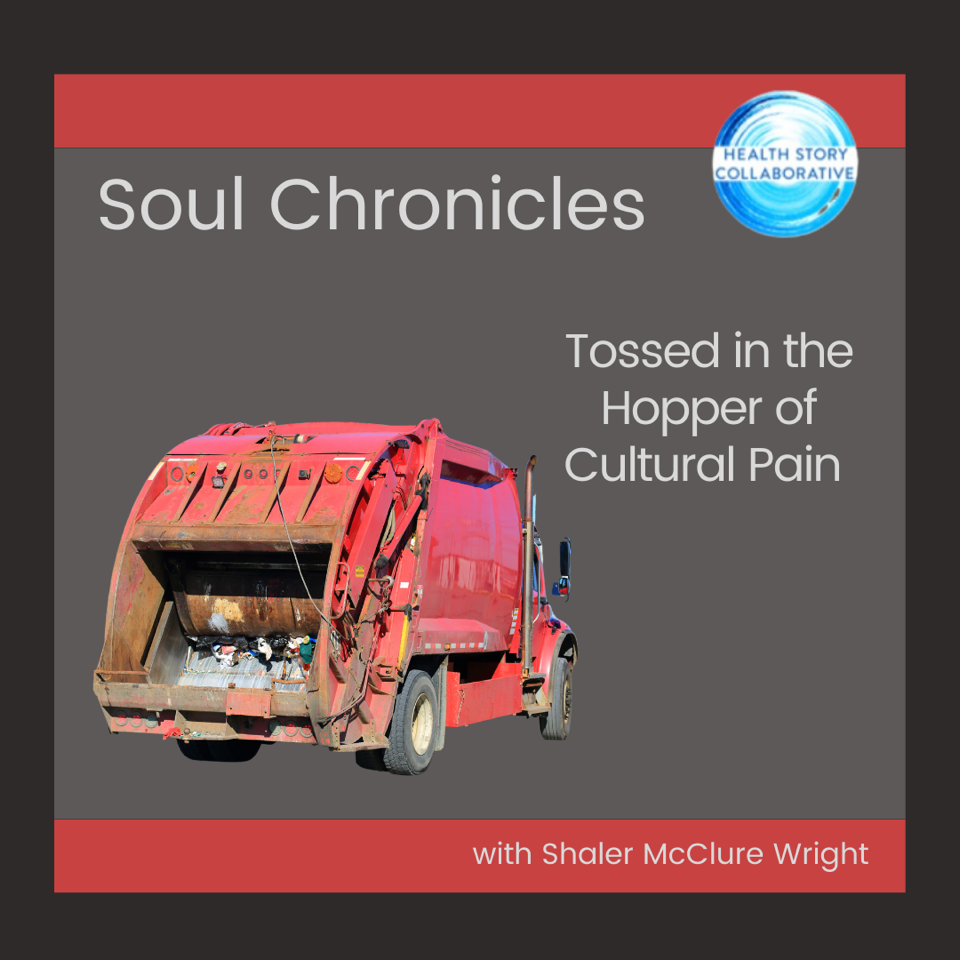
Soul Chronicles: Tossed In The Hopper Of Cultural Pain

Segment 9 in our series Soul Chronicles for the Chronically Ill

by Shaler McClure Wright

Introduction

You’re listening to episode nine of Soul Chronicles, offering a soulful perspective on how to navigate the unique challenges of living with ongoing health conditions. Special thanks to Health Story Collaborative for hosting this monthly audio column. My name is Shaler McClure Wright and I’m a writer/creative living with Chronic Inflammatory Response Syndrome.


Story - Tossed in the Hopper of Cultural Pain


When I think of a soulful approach to life I think of seeking beauty. Calling attention to beautiful moments as they unfold, or reflecting on those that may have passed without notice. But right now I’m immersed in its opposite; something shadowy and so ominous it can’t be ignored. So here is my warning—if you’re looking for butterflies, glitter and light, you won’t find them here today. Because before I can make my way back to the restorative path of all-things-good in the world, I need to acknowledge the looming presence of current events that threatens to eclipse the natural light of beauty and soul.


We’re in the grips of a pervasive cultural pain to which no one is immune. It’s uncomfortable, unsettling and it’s spreading. When we try to discuss it publicly, we strain for civility, and find ourselves having to avoid words that might be considered inflammatory, and sometimes that leaves us without words at all.  So we’re stuck in a cycle of speak/regret/retreat, and each round of failed conversation creates more pain.


I’ve chosen a name for this condition. Sanitation Syndrome.


I call it Sanitation Syndrome because ironically, the more we try to sanitize it, the more we enable it to grow. By sanitize I mean making light of divisive comments or avoiding conversation about it altogether. And if left unchecked, Sanitation Syndrome will gather strength, brewing in the background, until all of a sudden we find ourselves steeped in a national infection.


How do we learn to recognize it? Sanitation Syndrome occurs when words are weaponized to divide us, and once divided, we can no longer speak the same language. The best word to describe Sanitation Syndrome is toxic, and our well-intentioned attempts to contain it actually end up making things worse, by compressing it into something smaller, more dense and more toxic. Sanitation Syndrome is spreading through every corner of our country by seeping into our bodies with just enough heat to smolder, like a fire that burns from the inside out.


In order to reflect on this national illness (though I’d still prefer to reflect on beauty), I’ll choose an image to represent the aspects of Sanitation Syndrome that are hardest to visualize. Not surprisingly, I’m choosing a piece of sanitation equipment—a garbage truck—to represent the vehicle for both its containment and growth.


Imagine one big national garbage truck making rounds on a sweltering summer day with the purpose of containing all things exposed to Sanitation Syndrome—including people. It’s like we’re all being unceremoniously tossed in its hopper, with its giant compactor pressing us ever closer together, until finally we’re squished into one big brick of unrecognizable waste. And once we’ve been reduced to garbage, we begin to simmer with a smell most aptly associated with toxic stew. We think our lives will be less messy if we compact the trash.  But as it turns out, compacted trash takes up less space, but it’s no less nasty. It’s simply more concentrated.


I admit, I’ve tried to insulate myself from the reaching arms of our national garbage truck, but in doing so my world has grown smaller and smaller. And that’s not good. Truth is, Sanitation Syndrome is fueled by the pain of despair, and no amount of padding is thick enough to insulate us from its friction or burn.


It’s not that I don’t care about the issues we face—I care deeply—but like many of you, I need to balance awareness with health. And right now, to be honest,  I’m failing. When I clench with instinctive resistance, my desire for self protection feels like a vice tightening around my body. So insulation isn’t an option. We need to face this sickness head-on, or we might find ourselves wrapped in a vice and crushed in a hopper all at once.


When our lives have been compacted into one big brick of toxic waste it leaves us gobsmacked—shocked—and unable to think clearly.  It’s hard to take action. Like Bill Murray’s conundrum in “Groundhog Day,” waking up again and again to the same problems, we find ourselves stuck in the throes of recurring gobsmack attacks.


So how might we gain perspective about this predicament? By educating ourselves as much as we can. Think of it this way, learning about Sanitation Syndrome is not so different from hearing a diagnosis we don’t want to hear, or conducting research on a medical condition we’d rather not have—so perhaps we’re better prepared to do this work than we realize.


There’s something potent about the collective endurance of cultural pain, and the possibility leaves me wondering, “If enough of us can endure it, can we also clear it? Can we banish Sanitation Syndrome from our lives?”


I’ve spoken before about the transformative potential of personal experience and I’d like to share an example. Just yesterday I had an experience of uncontrollable trembling, for no apparent reason other than hearing the news stream in the background while I was cooking. Like the fire of Sanitation Syndrome—burning from the inside out—my trembling began as an invisible inner tremor. But eventually it got so bad I couldn’t hold a knife steady enough to chop vegetables.


Soulfully speaking, trembling can indicate a profound experience, transformation on a cellular level. Our body signals us with a combination of tears, rage, trembling, or dizziness. We might feel disoriented, but it’s actually a process of reorientation, and in the case of Sanitation Syndrome, a rejection. I believe a collective shake-out may be the best way to begin the process of collective healing.


In his book “Healing Trauma”, Dr Peter Levine suggests, “People do, in fact, possess the same built-in ability to shake off threats that animals do. I have found that, if given appropriate guidance, human beings can and do shake off the effects of overwhelming events and return to their lives.”


So if the first step is a shake-out, then the second step would be a reconstitution. How do we begin to transform our toxic stew into something more palatable?


Transformation is a complex and exhausting process, some of which is within our control, but much of it is a mystery, perhaps even requiring a leap of faith. And like our slimy, compacted waste, it can be messy. As an example, let’s look at the metamorphosis of a butterfly.


In the Scientific American article “How Do Caterpillars Turn Into Butterflies?”we learn that “first, the caterpillar digests itself, releasing enzymes to dissolve all of its tissues. If you were to cut open a chrysalis, you’d find a soupy meltdown of the caterpillar's body.”


Caterpillar soup contains highly specialized imaginal discs that undergo rapid cell division, differentiation and growth. Eventually these disks become imaginal cells that make up the physiology of a butterfly. The mystery of a butterfly’s transformation is rooted in these imaginal cells. (And of course I see a connection between the words imagination and imaginal.)


Evolution biologist Dr. Elisabet Sahtouris refers to the connection between the current state of our country and the birth of a butterfly in her book “EarthDance”:

“If we see ourselves as imaginal discs working to build the butterfly of a better world, we will understand that we are launching a new ‘genome’ of values and practices, to replace that of the current unsustainable system. We will also see how important it is to link with each other in the effort, to recognize how many different kinds of imaginal cells it will take to build a butterfly with all its capabilities and colors.”


So what do you think? Can we weather our Sanitation Syndrome garbage truck ride with the transformative grace of a butterfly? I warned you there would be no butterflies in this chronicle, and there aren’t. Yet. But we can visualize the possibility. And so I leave you with this vision of emerging beauty— Imagine how precious it would be to gather for a conversation that’s free of disinformation, flowing with words as beautiful as the first unfolding of a butterfly's wings.


Go here for more episodes of our Soul Chronicles series.


Shaler McClure Wright is fascinated with the mysteries of creative process, the healing power of creativity, and the creative synthesis of method acting, intuitive learning and depth psychology. A graduate of Wesleyan University and The Actors Studio, Shaler has worked as an actor, writer and educator for more than 40 years, and lives in southeastern Connecticut with her husband and son.

Website: www.shalermcclurewright.com

Instagram: https://www.instagram.com/soulchronicles22/, @soulchronicles22

BioSite: https://bio.site/soulchronicles


Q & A with Sarah Merrill, Personal Historian

Questions by Val Walker

Answers by Sarah Merrill

Sarah is a personal historian and owner of Merrill Memoirs (www.memoirsbymerrill.com). Since 2010, she has been assisting individuals, families and small businesses in recounting, recording, and preserving their stories. Sarah works with a talented genealogist to complete family research, and she contracts with a professional book designer to present her clients’ stories and photographs in beautiful books. She also teaches memoir writing workshops and serves as an editor for people writing their own memoirs of family histories.

Sarah earned her undergraduate degree with high honors in literature and creative writing at Middlebury College, Vermont, and completed graduate work in oral history and nonfiction writing at the Salt Institute for Documentary Studies in Maine.  She spent ten years in journalism before launching her personal history business.


Introduction

Have you ever engaged in a leisurely conversation with someone who not only listened to your story, but was fascinated in every bit of it? Indeed, your listener beckoned you to unearth memories that perhaps you had not thought about in years?

Sarah Merrill is this kind of listener. With genuine curiosity, she invites you to dive into all the details of a life story and discover the long-forgotten treasures that may have been buried for decades. With Sarah, your story’s details are for excavating, examining, saving, and savoring. And later, after selecting your stories, she artfully crafts a narrative of your life to create a memoir or a family history book, or more loosely, a collection of personal stories on a beloved topic. This intricate and complex work is generally what a personal historian such as Sarah does. Experienced personal historians combine the expertise of active listening, archiving of artifacts, genealogy, narrative writing, ghost-writing, book production, self-publishing, and more.

In the following interview with Sarah, I hope to introduce readers to the vital work field of personal history.

Val: A personal historian needs to be talented at writing as well as adept at engaging people and listening--and yet, needs to be impeccably accurate and organized. This is a very particular mix of gifts to have. How did you get started at this?

My interest in collecting stories and memories actually started when I was just a kid. I seem to have been born nostalgic! I always kept diaries and scrapbooks and saved every letter I ever received. I also was very enamored of my grandparents. I really wish I’d been enlightened enough to record their stories while they were still here. This is one of my regrets and part of what powered my inspiration to become a personal historian. In addition to being a collector and memory keeper, I was a storyteller. I read a great deal and I wrote stories all the time. I studied fiction writing in college and those skills are absolutely employed when I’m writing memoir and family history. In addition to accuracy, an important goal is for the narrative to be an engaging read!

Val: Could you tell me more about what is involved when you listen to peoples’ stories in your work? How do you get them to relax and delve into their recollections with such vivid detail?

As personal historians, we are very client focused in our work. Listening is about building trust. Trust is key.  This means I don’t want to force the narrative or push someone to get to the point. Instead, I gently allow them to discover and explore as they travel back in time. I often spend upwards of eight hours with my clients, spread over a few days, so they have ample time to cover a lot of ground. In telling their stories freely, without trying to meet any external criteria, my clients have the control, they choose what to share.  In some cases, the experience of sharing a story can be enlightening as well as enriching. And sometimes, they’ll tell a story just to get it off their chest, but then decide not to include it in the final product.

Val: This reminds me of an important technique in psychology and counseling, developed by Alfred Adler. Adlerian approaches are invested in early childhood recollections and how we find meaning and wisdom in these old narratives.

I believe at different times in our lives, we can revisit our stories and discover new takeaways by seeing details or patterns we’d never noticed. We can look at a relationship over time and see patterns or healing. We can even look at a trauma in new ways and sometimes find healing. It’s important to point out that I am not anything like a therapist. I’m more like a guide on a journey of life review. And life review has many, many benefits. Though some topics may be too difficult, and I always let people know it is completely fine to leave them out.

Val: It sounds deeply meaningful to help people value their stories as history.

One of my clients getting a first look at her family history book. In this case, this was the third book I produced with her.”—Sarah Merrill

My work is rewarding on multiple fronts. We can help clients understand the impact of peoples’ struggles and challenges in their families over the decades. In reviewing our life stories, we can sometimes more clearly see the influences that people have had on us, on our families, our communities over time. We can see the impact we’ve had on others around us. We can see our own challenges from a new perspective. Our children and grandchildren can be enriched by what our family members have faced and battled through generations.

Val: Is the field of personal history becoming more popular?

The field of personal history is still not well known—not yet, really. But fortunately, interest in the field of genealogy has greatly increased in recent years. And in the first year or so of the pandemic, people had more time to reflect. Folks pulled out photo albums or downloaded a genealogy app. The interest in genealogy has sparked people to learn more about their ancestors and families and has helped lead them to the field of personal history and writing memoirs. But there is a significant difference between genealogy and personal history. Certainly, personal history complements and includes genealogy. I work closely with a genealogist in my business.

Val: When did you actually discover there was such a thing as personal history and give yourself a professional name, “personal historian?”

At some point, I was aware that I wanted to work with individuals and families to record their stories, but I did not know there was a field called “personal history” or that others were already doing this. I’d volunteered in a nursing home helping elders write their memoirs and it struck me then how rewarding it was. Especially visiting these fairly isolated and lonely elders and actively listening to them, taking an interest in their lives.

Around 12 years ago, when I was working as a journalist and a medical writer, I learned through a newspaper article of a man who was working as a personal historian – and it all just clicked into place. He was gracious enough to meet with me and discuss his business model. And from there, my dream gradually became a reality. I slowly built my business as a professional personal historian with my company Merrill Memoirs. I’ve been doing it full time for about 10 years and have written dozens of memoirs and family histories.

Val: What types of people come to you for your services?

I’m either hired by the individual themselves – typically aged 60 to 100 – or by their adult children or their grandchildren, who want the stories recorded. People are realizing they need to get their loved one’s stories recorded before they are gone. Sometimes, the older generations may be reluctant to be the center of attention like this. I sometimes hear, “Why would anyone want my stories? I’m not interesting!” But truly, once they begin the story sharing process, they realize how wonderful it can be. I often have people express disappointment when our interviews are completed.

Further Reading

  • To learn more about Sarah Merrill and her services: www.memoirsbymerrill.com

  • To learn more about personal historians in the Northeastern US: Personal Historians Northeast Network www.phnn.org


Val Walker is a contributing blogger for Psychology Today and the author of 400 Friends and No One to Call, released in 2020 with Central Recovery Press. Her first book, The Art of Comforting (Penguin/Random House, 2010), won the Nautilus Book award and was recommended by the Boston Public Health Commission as a guide for families impacted by the Boston Marathon Bombing. Val received her MS in rehabilitation counseling from Virginia Commonwealth University and is a rehabilitation consultant, speaker, and educator. Keep up with Val at www.ValWalkerAuthor.com

Soul Chronicles: The Bittersweet Pain of Letting Go

by Shaler McClure Wright

 Segment 8 in our series Soul Chronicles for the Chronically Ill

Introduction

You’re listening to episode eight of Soul Chronicles, offering a soulful perspective on how to navigate the unique challenges of living with ongoing health conditions. Special thanks to Health Story Collaborative for hosting this monthly audio column. My name is Shaler McClure Wright and I’m a writer/creative living with Chronic Inflammatory Response Syndrome.


Story - The Bittersweet Pain of Letting Go


When life is changing, it can be hard to stay connected with your feelings. And for me, it’s especially difficult when a big change is happening slowly over time. Sometimes it takes a certain moment—an image etched into our imaginations—to trigger awareness and orient us to the deeper truth at the heart of the change. Last week I had such a moment. 


Every spring we take our boat out of winter storage and prepare her for the season. And when she’s finally in tip-top shape on launch day, we set off on a maiden voyage across Long Island Sound to circumnavigate Fisher’s Island. Some years are colder or foggier than others, but regardless of the weather it’s always been a joyful tradition, celebrating the start of the summer fun.


Last week my husband and I layered-on the foul weather gear and headed out. I took my usual seat in the bow. It was chilly so we had the Sound to ourselves, seeing only two boats in the distance while crossing. Normally that would fill me with an expansive sense of freedom and peace. But instead, I found myself feeling trapped, tight-chested and choking back tears as we approached the island. Normally the beauty of this island gives me a sense of safety, but this year, as we rounded the western tip, my heart felt like it was being sucked into the sea, never to surface again.


What was this pain about?


Like most people who live with chronic illness, I’ve developed techniques to cope with physical pain. But I wonder—can I use those same techniques to cope with emotional pain?


My only child is graduating from high school this year, marking the beginning of his life as an adult, and the end of his life as a child. It’s a threshold experience—as described in last month’s Soul Chronicle—and a time for joy and celebration. But for me as a parent, with that joy also comes the bittersweet pain of letting go.


Susan Cain, author of Bittersweet; How Sorrow and Longing Make Us Whole, describes this beautifully, “Bittersweetness is a tendency to states of long­ing, poignancy, and sorrow; an acute aware­ness of passing time; and a curiously piercing joy at the beauty of the world. It recognizes that light and dark, birth and death—bitter and sweet—are forever paired.”


I believe many of us who have made peace with chronic illness have also embraced the beauty of life’s bittersweet pairings, but we may not know it. I didn’t know until reading Cain’s words. Now I can see that each time I’ve needed to muster courage to deal with a new prognosis, or face the loss of some aspect of life-as-I-knew-it, there’s been an element of bittersweetness leading me forward to acceptance.


Today I want to imagine my way through the bittersweet challenge of letting go of my role as protector of my child, in order to embrace a new role as his liberator. And to do that, I”ll return to my story of annual maiden voyages in our motor boat.


Boating is the glue that holds our family together. We love to escape the daily grind and commune with nature at sea. Preparing a boat for her maiden voyage is a labor of love, and in this way it’s similar to preparing to launch a child into independence. If you’ve maintained a sturdy vessel, then she’ll be able to make her way through the sea because she’s solid and seaworthy; so too, if you’ve raised a resilient child, he should be able to make his way in the world on his own.


My son Jasper was an infant the first time we took him on a maiden voyage. To mark the occasion, we bought a large marine bean bag and placed it between our pedestal seats so he’d  be nestled safely between us while we were under way. It takes about an hour to circle Fisher’s Island and we thought that would be long enough for his nap. But no! He just loved the purr of that engine! That year, he was so comfortable and in such deep sleep we had to go around the island twice to avoid waking him. And even though the waves were choppy, he was safe and cozy in our care. The image of him sleeping in that bean bag wearing his red knit cap, clutching a pair of orange velour kitties–one in each hand–is one of my favorite memories.


At age six Jasper was a bundle of curiosity, and finally old enough to appreciate our self-guided Fisher’s Island trivia tour. On that year’s maiden voyage, we revealed to him that Fisher’s Island was chosen as the location for a feature film. On its wild and windy west side, there’s a big white shingled house with a wide wrap-around porch and sea-gazing gazebo, where the movie The World According to Garp, starring Robin Williams, was filmed.


The property includes a small rocky beach, where the wave action can be quite rough. In the movie, Robin Williams calls out to his young son, who is swimming alone for the first time, “Watch out for the undertow!”—a helpful warning from a concerned parent. But that’s not what his son heard. His son heard ‘watch out for the undertoad,’ and from then on he was terrified of a dangerous frog lurking beneath the surface of the water waiting to pull him under and suck him out to sea. Jasper laughed with delight (and perhaps a slight air of superiority) at the idea of such a silly, superstitious child.  And his confident smile while staring at that rocky beach that day is another favorite memory.


When compared with memories from those two maiden voyages, the images from this year’s maiden voyage are stark. If I were to hold all three memories  side by side—like a triptych—in my imagination, in the first frame I’d see two smitten parents beaming over their helpless, dependent infant; in the next I’d see two proud parents beaming over their clever, confident kid; and finally I’d see two lost parents scanning the coastline for something that’s missing—the continuing presence of their only child.


Ack! How depressing! How might I reframe this triptych?


Let’s take a deeper look at that memorable line from the movie—“Watch out for the undertoad.” The first time I heard it, I simply thought it was funny, but over the years,  layers of questions beneath the words have begun to reveal themselves. Such as… How often is a cautionary phrase from a parent misunderstood by a child? And…How often do we parents, in our desire to keep our children safe, cause more harm than good with our advice?


Author John Irving knew this line would have the greatest effect when spoken by a parent to a child. Coming from a parent, it can be taken at least two ways: as an honest expression of concern for safety, and as an ill-fated attempt to control what is beyond his control. Both are very effective for the book’s plot. But the backstory to that line will show us it evolved from a very different circumstance.


Ironically, the line ‘watch out for the undertoad’ came from real life, and the words were first spoken by a child rather than an adult. John Irving’s eldest son Colin said it to his younger brother Brendan, who was just six years old.  And from then on, young Brendan was afraid to swim in the ocean.


The layers of meaning within his words were not lost on Colin, and he even understood why his father decided that for the book, the words carried more literary impact when spoken by an adult. Yes, at age twelve Colin understood that if his father switched the character from child to adult it would make the reader question the concept of safety more deeply. In a 2018 interview with Esquire magazine, Irving said his son Colin was also the first one who zeroed in on the main theme of the book. Colin told his father, “If Garp could have been granted one wish, it would have been that he could make the world safe. For children and for grownups.” ‘Watch out for the undertoad’ represents our misguided attempts to do so.


No matter how much we want the world to be safe and stay the same, there’s nothing we can say or do to fully avoid risk or change. That’s as true for those of us with chronic illness as it is for parents. Despite our best wishes to offer valuable advice and guidance, and no matter how much we try to prepare our kids–or each other–for the world, we shouldn’t be surprised if our wisdom and guidance is not enough or lost in translation. And when push comes to shove, we might need to admit that we’re not the great, all-knowing teachers we’d like to be. In fact, we might even need to humble ourselves enough to learn a lesson from our children, just as John Irving received insight from his son Colin.


In the context of high school graduation ‘watch out for the undertoad’ is symbolic of my fear of  letting my child go out in the world on his own, but I can also hear it as a clarion call for people with chronic illness. We too need to watch out for dangers that may be lurking in the unknown. Medicine is an evolving science and despite the best care and advice from the people we love and admire, it’s up to us to make decisions to keep ourselves safe.


For me, the emotional journey of letting go of  my child has not been as clear-cut as the symbolic gesture that often marks this occasion. The child’s gesture of donning a graduation cap and flipping the tassel from one side to the other seems so matter of fact, when compared with the emotional turmoil I feel as a witnessing parent. How can a transition that makes me so very proud, simultaneously fill me with mind-numbing pain?


Perhaps the pain I feel as a parent is most closely related to fear of my son’s uncharted future. And if John Irving’s son Colin is right, then perhaps the process of setting my child free to pursue his own life is more about fear for his safety, rather than fear of my own loneliness. That would mean my pain is rooted in love rather than selfishness, and that makes it bittersweet.


When pain is looming like an undertoad beneath the surface of a fast-approaching future, I think we can feel confident that the skills we use to make peace with chronic illness will also help us make peace with the undertoad. The tension between facing loss versus denying loss is familiar to us. Our experience of ‘letting go of health as we knew it’ is an example of the bittersweet pain of letting go.


Right now, my imaginary triptych of maiden voyages ends with an image of loneliness, and I’d like to transform that. What might be a better ending? Let’s imagine a new maiden voyage, but with one big difference–This time I’ll visualize Jasper leading the way at the wheel of his very own boat, shouting back over his shoulder to my husband and me as he races through the current off Garp’s beach, “Mom, Dad! Watch out for the undertoad!”


Opening ourselves to learn from our children is one of the unexpected gifts of parenting. Opening ourselves to learn from our fears is one of the unexpected gifts of living a soulful life and embracing the bittersweet. Both can lead us to deeper truths. Thank you for investigating the deeper truth at the heart of high school graduation with me today, and helping me build the courage to watch my son flip his tassel from one side to the other on graduation day without worrying myself sick. Because if I’ve done my job well, he will be just fine without me.


Go here for more episodes of our Soul Chronicles series.


#                     #                     #


Shaler McClure Wright is fascinated with the mysteries of creative process, the healing power of creativity, and the creative synthesis of method acting, intuitive learning and depth psychology. A graduate of Wesleyan University and The Actors Studio, Shaler has worked as an actor, writer and educator for more than 40 years, and lives in southeastern Connecticut with her husband and son.

Website: www.shalermcclurewright.com

Instagram: https://www.instagram.com/soulchronicles22/, @soulchronicles22

BioSite: https://bio.site/soulchronicles

The Mystery of Granuloma Annulare: Part II - A Photo Essay

By Braiden Rex-Johnson

The skin is the largest organ in the body. And when something in the body’s largest organ goes awry, it can create havoc in a patient’s life.

I suffer from a skin disorder called Granuloma Annulare (GA). It is characterized by red circles, raised spots, pink and purple patches, crusty plaques, and subcutaneous bumps.

Parts of my body look like that of a burn victim; others areas like a leopard. I liken my skin to a Modernist painting.

For the most part, I try to hide myself from neck to ankles under long-sleeved shirts and full-length pants whenever I leave the house.

But out of the ugliness of GA can come beauty when photos of the bumps and patches are turned into watercolor-like “paintings.” If you look hard enough and let your imagination run free, you can discover a fascinating collection of objects among the patches and lumps on the landscape of my ever-changing skin.

Here is The Calm Before the Storm.

And this is Bunny Rabbit.

Here is Africa.

This one is entitled The Continents.

And, finally, the vivid hues of Violaceous.

Braiden Rex-Johnson
Soul Chronicles: On Thresholds, Rabbit Holes, Wardrobes and Transitional Space

Segment 7 in our series Soul Chronicles for the Chronically Ill

By Shaler McClure Wright

Audio Story Transcript


Introduction

You’re listening to episode seven of Soul Chronicles, offering a soulful perspective on how to navigate the unique challenges of living with ongoing health conditions. Special thanks to Health Story Collaborative for hosting this monthly audio column. My name is Shaler McClure Wright and I’m a writer/creative living with Chronic Inflammatory Response Syndrome.


Story - On Thresholds, Rabbit Holes, Wardrobes and Transitional Space


Can you remember the most significant days in your life? I bet you can, because the events on those days were most likely threshold experiences, and as such, they’ve received a special place in your memory, preserved with almost cinematic detail.


Most commonly, the word threshold refers to a place where you make a physical crossing—like walking over the sill of a doorway or through the entrance of a building. But it also refers to various points of ‘beginning’ that can be cultural, psychological or emotional—as in rites of passage or life’s milestones. Similar to a crossroad, a threshold requires a choice to be made, a leaving behind to gain something new. But a threshold also contains an additional component—the transitional space of in-between.


Līmen is the Latin word  for threshold; Līmen refers to the border between one thing and another. And within this borderland is something called liminal space—which can be thought of as the transitional space between two locations or phases.  An example of this, in the literal sense, could be the walls of a tunnel through which one must pass. An example in the metaphorical or symbolic sense might be the period of engagement between a marriage proposal and the wedding. In both instances the transitional space holds an aura of other-worldliness–a heightened sense of reality where unusual things can happen.


Jungian analyst Katherine Olivetti suggests that navigating thresholds and transitional space requires new attitudes. She says, “The experience can be felt as frustrating, painful, exhilarating, challenging, frightening or liberating … This is a place where the opposites are not clearly defined, where rules are suspended, collisions abound, and new possibilities emerge.”


Sounds frightening to me, but it also sounds thrilling.


When friends and family undergo a threshold experience, I’m especially drawn to their stories of time spent in the transitional space of in-between, because that time can have a mystical, almost magical quality, fostering breakthroughs to new ways of thinking and being. A dramatic example of this could be the story of a near-death experience.


Thresholds are places of potent energy. The emotional energy involved with facing a threshold is complex and often contradictory. It can swamp you with a sense of overwhelm, or elevate you to a new perspective with more clarity. So when life accelerates and change is imminent, it’s wise to become well-practiced in moderating your response.


As Irish poet John O’Donohue has described, “A threshold is not a simple boundary; it is a frontier that divides two different territories, rhythms and atmospheres.” Indeed. Each time we find ourselves standing at a threshold, we also receive an implicit invitation to reconsider our priorities and attachments. And that takes courage and practice.


Thresholds often accompany the milestones in life, and if I think about it honestly, my emotional response to those occasions has rarely been one-dimensional. Maybe that’s true for you, too. In fact it’s quite likely a threshold experience will stir up all kinds of conflicting emotions, even if the threshold is one to celebrate. And those emotions can wreak havoc on our ability to think, feel or see clearly.


O’Donohue believes the emotional intensity of a threshold experience is connected to fear of change. “To change is one of the great dreams of every heart – to change the limitations, the sameness, the banality, or the pain… But change is difficult.” Along with courage, we also need trust. “To acknowledge and cross a new threshold demands a sense of trust in whatever is emerging.”


But courage and trust take time to develop. Perhaps transitional space exists because it is needed. When we’re in the midst of a threshold experience, we need the transitional space to give us time to develop courage and trust. Here’s an example of what I mean:


I remember how I felt on the day I first received my diagnosis. Time stood still and my mind went gray.  I felt a physical sense of standing in between ‘life before’ and ‘life from now on.’ I remember feeling shaky and uncertain. It was scary, but now I recognize it’s common to feel that way while standing in transitional space. That space is where I mustered my courage. That space between two points of being. Between what was familiar and what is unknown.


Because of our medical challenges, thresholds are likely to be familiar to those of us who have faced the reality of chronic illness. And I believe our experience can give us a leg up when it comes to helping others who are facing thresholds of their own. Should the opportunity arise, we are primed through our experience to be valuable threshold guides. I hope to talk more about how we might serve as valuable threshold guides in the next Soul Chronicle.


I also believe those of us with ongoing health conditions can develop special strengths. For instance, in order to balance truth with hope, we might find ways to pair child-like curiosity with adult-like courage. Or we might learn to find beauty in loss, or learn to take strength from facing disappointment or the unknown.


The ability to engage with change is most effectively fostered in childhood. When I think of well-known threshold experiences, I find myself remembering images from childhood literature. Most of the storybook characters I continue to admire have navigated a significant threshold with child-like curiosity, and through their experience, have grown wiser to tell the tale.


Let’s take a closer look at two of these characters; Alice, from Lewis Carroll’s “Alice’s Adventures in Wonderland,” and Lucy from “The Lion, the Witch and the Wardrobe” by C.S. Lewis. Alice begins her series of threshold experiences in a mad rush, while Lucy begins with careful consideration of her transitional space.


First, here’s Alice in the passage when the rabbit first captures her attention:


“It flashed across [Alice’s] mind that she had never before seen a rabbit with either a waistcoat-pocket or a watch to take out of it, and burning with curiosity, she ran across the field after it, and was just in time to see it pop down a large rabbit-hole under the hedge. [And] in another moment, down went Alice after it, never once considering how in the world she was to get out again.”


The rabbit-hole is a threshold.  But Alice didn’t pay any attention to the transitional space in-between the entrance and the exit. She also never took time to consider the risks of going down the rabbit-hole; instead she was completely driven by impulsive, child-like curiosity. And that’s a good place for a child to start, but it deprives her of the wisdom she might’ve gained during the transition. As the story continues, Alice is faced with more threshold experiences, and with each one she opens herself up a bit more to the mysteries of transitional space. And her growing discernment and worldliness is representative of how we too, might grow in our own experience.


Now let’s consider a passage in “The Lion, the Witch and the Wardrobe” where young Lucy decides to push her way through a secret entrance to a magical world hidden in the back of a wardrobe full of old fur coats.


“She went further and found a second row of coats hanging up behind the first one. It was quite dark and she kept her arms stretched out in front. She took two or three steps further in. [...] Then instead of feeling the hard, smooth wood of the floor of the wardrobe, she felt something soft and powdery and extremely cold. [...] The next moment what was rubbing against her face and hands was no longer soft fur but something hard and rough and even prickly. ‘Why, it is just like branches of trees!’ exclaimed Lucy. And then she saw a light a long way ahead of her. Something cold and soft was falling on her.[...] She was standing in the middle of a wood at night-time with snow under her feet and snowflakes falling through the air. Lucy felt a little frightened, but she felt very inquisitive and excited as well.”


Unlike Alice, Lucy took the time to experience every sensory element during her transition, and because she was grounded in the physical reality of her surroundings, I believe she was able to move past her fear and face the magical, snowy woodland with the same excitement as an explorer in the age of discovery.


Lucy’s flexibility and open mind serve as examples of the kind of strength to be gained from a threshold experience. And both of these qualities are available to those of us who pass through medical thresholds as well.  Although a threshold can feel like a curse at the time of occurence, in retrospect, I believe it is a gift. Especially since part of the challenge of being chronically ill is to feel and face every dimension of the experience, rather than dissociating.


If we can stay present, then with every threshold experience of transitional space comes an opportunity to become both wiser and deeper. And every time we become wiser and deeper, we are also becoming more soulful.


Go here for more episodes of our Soul Chronicles series.


Shaler McClure Wright is fascinated with the mysteries of creative process, the healing power of creativity, and the creative synthesis of method acting, intuitive learning and depth psychology. A graduate of Wesleyan University and The Actors Studio, Shaler has worked as an actor, writer and educator for more than 40 years, and lives in southeastern Connecticut with her husband and son.

Website: www.shalermcclurewright.com

Instagram: https://www.instagram.com/soulchronicles22/, @soulchronicles22

BioSite: https://bio.site/soulchronicles

The Mystery of Granuloma Annulare

By Braiden Rex-Johnson

Television advertisements for well-known disorders such as psoriasis, rheumatoid arthritis, and asthma tout new wonder drugs that can clear plaque-ridden skin, improve the pain of damaged joints, and help people breathe more easily, respectively. But for sufferers of granuloma annulare (GA), there is no magic panacea that will stop the unsightly red rings, violet patches, oozing plaques, and painful nodules that can pop up anywhere on the body.

My own case of GA began in the spring of 2017. I was 61-years-old when a red ring, about the size of a quarter, popped up on the back of my right hand. The ring was slightly raised and a bit itchy. At first, I dismissed it as an insect bite or a pesky skin eruption and hoped it would just go away. But on an otherwise ordinary Saturday afternoon, while we were sharing fajitas at our favorite Mexican restaurant, my husband asked about the strange circle on my hand. It was then that I realized I needed to see a doctor STAT.

My primary-care physician thought the circle might be ringworm. But when a course of antifungal cream didn’t help, she prescribed a strong steroid cream. Even that didn’t faze it. And within weeks, I watched helplessly as red spots about the size of nickels started appearing on the backs of my pale and—until then—blemish-free legs. I watched in growing alarm as a smaller red spot sprang up on the outside of my left knee; then one on my right elbow. My skin was turning into a Modernist painting before my eyes as the angry red bumps spread over my extremities.

What were these strange spots? What if they spread to my face? I had always taken good care of my skin, choosing unscented products, moisturizing my body, and slathering on sun screen, so why was it turning against me now?

I made an emergency appointment with my long-time dermatologist. He agreed that my condition was most likely GA. To confirm the diagnosis, he anesthetized one of the most prominent bumps, then “punched” a small plug from its center. After examination by a pathologist, this “punch biopsy” confirmed that I had GA, and all of this just six weeks after the pesky red ring first appeared.

My dermatologist suggested starting intralesional corticosteroid injections with a drug called Kenalog. He said he hoped the under-the-skin injections would make the bumps go away, or at least calm the inflammation and help them fade over time.

Injections?!?! I had always been afraid of needles, and there were so many places to inject. The thin needles in the Kenalog-filled syringes moved over my body like a swarm of angry bees stinging their way across my torso. Sensitive places like the backs of my knees, under my breasts, and near my groin especially hurt. Sometimes I flinched and grimaced, unable to control my body movements.

To help ward off the pain, I often held my breath and pretended I was elsewhere. When the torture was over, I looked down at the examination table and saw red spots—my blood—spattered on the protective white paper where I had just laid. Although painful and unpleasant, the “jabs” became a necessary evil. I remained ever hopeful that they would make my GA go away, since my dermatologist kept predicting that it would most likely "burn out" within a year or two.

But it didn’t. The injections helped flatten the bumps and lighten the patches, but new lesions would simply pop up in different places. One time, after undergoing what seemed like hundreds of “jabs,” my doctor said that injecting me “was like a game of whack-a-mole.”

Granuloma annulare is an ugly disease, both literally and figuratively, affecting both mind and body. The uncertainty and unpredictability of this disorder—knowing it is roiling deep inside your body, ready to spring up anywhere and at any time—is one of the most unsettling and frustrating things about it.

Somehow, my precious husband of 40 years manages to see past my imperfect exterior. And a kindly nurse once said one of the patches looked like a butterfly tattoo! Still, I can’t imagine being diagnosed as a child, trying to navigate the dating scene, or going through GA alone. I am thankful we live in the Pacific Northwest, where I can hide my spots most of the time.

Since my diagnosis more than four-and-a-half years ago, I have learned a lot about GA, which translates from Latin as “inflamed ring” and is more correctly known as necrobiotic papulosis. The “inflamed rings” of GA were first reported in 1895 in the British Journal of Dermatology. According to a recent article in the American Journal of Clinical Dermatology, it is a rare disease, affecting just .04% of the United States population. Women are three times more likely to suffer from it than men, it most often occurs in the fifth decade of life, and is more prevalent among Caucasians.

The exact cause of GA is unknown, although some believe it is a result of trauma or injury to the skin (such as an insect bite), sun exposure, viral infections, or vaccinations. People with GA sometimes also suffer from thyroid disease, diabetes mellitus, and autoimmune diseases such as rheumatoid arthritis and lupus. The good news is that GA is neither cancerous nor contagious. The bad news is that some people experience pain, itching, burning, and perforations in their skin.

Granuloma annulare most often appears on the hands, wrists, feet, and ankles, although sometimes even on the face. It comes in different forms. The localized type often occurs in children, the rings are confined to one area, and sometimes it goes away spontaneously. Subcutaneous GA, also mainly seen in children, is less common and appears as rubbery lumps.

Perforating GA forms crusty yellowish plaques, mostly on the hands. The patch type presents as pink, red, or purplish patches and usually affects females over the age of 50. Generalized, or disseminated GA is diagnosed when a patient has more than 10 spots. More common in adults, generalized GA tends to be more persistent, is difficult to treat, and can last for decades, sometimes never resolving.

Because the underlying cause of this disorder is unknown, finding a gold-standard treatment that works for every patient is difficult. I have tried first-line options, including steroid creams and injections, and a third-line treatment, phototherapy (treatment with strong lights) without success. Through my research, I learned that certain prescription drugs have helped resolve some recalcitrant cases of GA. However, many dermatologists (including my own) are reluctant to prescribe them because they have not received FDA approval for use in GA, clinical trials are small or nonexistent, and side effects can be serious.

But after suffering for so long, I was getting desperate. And when my husband said he would be willing to “go to Mayo Clinic or anywhere else in the world to get me fixed,” I knew I had to do something drastic. Thankfully, we didn’t have to travel far afield. In January 2022, I found a dermatologist at a local teaching hospital who was willing to prescribe an oral drug called Hydroxychloroquine (yes, that Hydroxychloroquine!). Although it is more commonly used to prevent or treat malaria, rheumatoid arthritis, and lupus, Hydroxychloroquine has shown promise in patients with tough cases of GA.

My new doctor explained that while steroid injections can help, they don't address the underlying cause of GA. After explaining possible side effects (atrial fibrillation and retinal problems) she advised me to start taking Hydroxychloroquine twice a day for four to six months, and return for a three-month check-up.

I was overjoyed! If it worked, it meant no more fiddling around with creams, injections, or light therapy. But the first doses were tough. Nausea, dizziness, and unsettling dreams lasted close to a week, but eventually my body adapted. I am already seeing improvement, but even if Hydroxychloroquine doesn’t work or eventually stops working, my doctor said there are other drugs to try, always walking the fine line between side effects and efficacy.

Late last year, I discovered the Granuloma Annulare Support Group, a private Facebook group that was started in 2015 and now numbers close to 8,000 members from across the globe. Although this is a group none of us ever wanted to join, members are compassionate and caring. Sharing stories and photos has improved my mental attitude and helped me realize I am not alone. Misery loves company. When members were asked to describe GA in one word, the answers were heartbreaking: Evil, annoying, constant, perplexing, creeping, depressing, life-changing, relentless, unwanted.

Granuloma annulare is all of these and more. Yet the promise of systemic drugs offers GA sufferers something that is often in short supply: hope. And maybe someday, GA sufferers like me will be able to turn on the television and exult in advertisements that tout our very own wonder drug.


Braiden Rex-Johnson is a retired food-and-wine writer, the author of seven published cookbooks, and the owner/founder of www.SeattleWaterfrontWebcam.com.

Instagram

Facebook

LinkedIn

Website

Braiden Rex-Johnson
Soul Chronicles: Standing Watch in the Sleepless Sea

Segment 6 in our series Soul Chronicles for the Chronically Ill

by Shaler McClure Wright

You’re listening to episode six of Soul Chronicles, offering a soulful perspective on how to navigate the unique challenges of living with ongoing health conditions. Special thanks to Health Story Collaborative for hosting this monthly audio column. My name is Shaler McClure Wright and I’m a writer/artist living with Chronic Inflammatory Response Syndrome.

Standing Watch in the Sleepless Sea

Being awake at night when the world is asleep is like standing watch on a ship at sea. After a few hours of staring into the distance, you might feel isolated, fearful and uncertain if you will ever dock in a safe harbor again.

Worries loom larger in the silence of darkness, just as rocks seem to rise out of nowhere. And once-familiar objects are shrouded in strange, threatening silhouettes. Many of us with chronic health conditions have sailed on the sleepless sea, and quite a few of us are frequent passengers.

I’ve been bunkmates with insomnia for decades. When I was in my 20s and 30s it was easy to shake off a sleepless night and function pretty well the next day. But now it takes a toll, and I’m learning to treat sleeplessness with new respect, as both a worthy adversary and instructive companion.

Being alone and awake in the night can be frightening. Nocturnal impressions are heightened. Even when we’re old enough to put aside our childhood fears of monsters under the bed, insomnia can feel like a giant presence, smothering you with unstoppable, oppressive force.

But it’s also true that the mystical aspects of darkness can serve as a gateway for visualization, opening us to new and unexpected points of view. And there’s a better chance of quieting our worries if we choose to walk through that gate without preconception or fear of where it might lead.

Here’s what I mean. These days, when I wake up in the wee hours (envious of my husband’s purring-ly deep sleep), I direct my attention away from the fuzzy shadows and inward to my imagination. Then I choose to visualize a different experience of the dark, from another time. I like to choose events that have held space in my memory, but may not yet be fully understood.  Most recently I chose to revisit my memories of midnight from a specific perspective— at sea…

Just after I graduated from college (a long time ago) I was invited to live and work with a family on a sailboat, as we voyaged from Finland to Sicily. During longer passages we followed a system called watch ‘n watch, which means round-the-clock sailing—four hours-on, four-off—with our crew split evenly between shifts. I remember how my crewmate would wake me for the midnight-to-four [shift], whispering as she gently rocked my shoulder, “Polaris is bright and winds are steady. But there’s ground fog, so you’ll be in the bow, on lookout.”

 Lookout was my favorite job, especially in the mystical hours after midnight. I loved to feel the cool dampness of night against my knuckles and cheeks as I scanned the horizon for buoys and bells.

 But not every watch is idyllic. In foul weather, sound is distorted by ground fog. All appears quiet until something pops—all of a sudden—out of the darkness. At first it’s hard to tell how far away that something is, and your emotions can run the gamut from startled to fearful to attentive.

 It’s only in the attentive phase you can accurately make out shadows in the dark. Flotsam and jetsam float by without harm, and passing ships appear farther away than they actually are. Sound is muffled by moisture until it’s upon you. Most nights the sounds of the sea are soothing, but in foul weather, there are sounds that can rattle your soul.

 On one particular stormy night, as we were exiting the English channel and rounding the isle of Ushant to seek shelter in Brittany, we had a force ten gale that was blowing us sideways. Our bow was caught under breaking wave after breaking wave, and our foredeck was awash with the weather. The storm was too fierce for anyone to stand in the bow, so I stayed amidship, fastening myself to the guardrail for safety.

 We made little headway during that storm, even with shortened sails and use of our auxiliary engine. Our 57 foot sailboat didn’t have radar, so our biggest worry was about inadvertently finding ourselves in the path of a monster tanker, too large and immobile to slow down.

 The English Channel is a busy shipping lane with freight crossing at all hours. We could hear the tankers but couldn’t see them, and it was my job to sound our air horn once every minute to make sure they could hear us. We could feel their wakes, still rolling underneath us, and we held our breath, hoping we’d never come close enough to to get sucked in by their propellers.

 Luckily, our horn was heard and that night the tankers passed at a safe distance. But it felt like forever before we could rest. Finally, in the wee hours of that sleepless night we made entry in the nearest port. But it was a commercial harbor, and it was full. We had no choice in the darkness but to raft our pretty white sailboat to a rusty old reddish tanker that was ten times our size. And for all we knew, it could’ve been one of the tankers that crossed our path in the channel, but now its immense steel hull was providing shelter to our windward side.

 That stormy night reminds me of my worst nights of insomnia. With no sense of how much time had passed, no sense of where I was, and no sense of what lay ahead, I felt small and powerless. The overwhelming size of the tankers felt a lot like the overwhelming force of insomnia, and their churning wakes felt a lot like the tossing and turning of a sleepless night.

 That storm taught me many valuable lessons. And one, unbeknownst to me until now, is worth repeating: Try to remain open to what frightens you; for the very thing you fear may become your protector, given time.

 Just as a tanker can change from danger to protector, imagine the experience of transforming sleeplessness into dreamfulness. For in our dreams and imagination, the desperation of insomnia can be transformed into an opportunity for self discovery.


Juan Ramón Jiménez, Nobel prize-winning poet from Spain, describes the pivot point between desperation and discovery in his poem, “Oceans”:

I have a feeling that my boat

has struck, down there in the depths,

against a great thing.

                    And nothing

happens! Nothing...Silence...Waves...

    —Nothing happens? Or has everything happened,

and are we standing now, quietly, in the new life?


On that night of the storm I feared our boat would be struck by a ‘great thing’. But instead, the ‘great thing’ that posed such a threat in the channel, changed its position  and rested quietly, in a new place, where we would encounter it once again, from a new perspective. The final gift of that storm was coming into port, casting our lines and making fast in the dark, only to discover by daylight that we had tied up in the lee of the same tanker that could’ve sunk us at sea.

 In its worst expression, insomnia can feel like a force ten gale blowing between our sheets. And after we’ve been swamped under the crests of its breaking waves, the potential insights to be gained at the bow of our ship of sleeplessness may feel out of reach. But over time, if we stay present, I suggest we can trust the afterstorm to settle.  And if we’re lucky, we may even find ourselves basking in the guiding light of the North Star, Polaris, as we make way, with a yawn, for safety and peace.

 So when you’re faced with sleeplessness, try to remain open to what frightens you; for the very thing you fear may become your protector, given time.


Go here for more episodes of our Soul Chronicles series.


Shaler McClure Wright is fascinated with the mysteries of creative process, the healing power of creativity, and the creative synthesis of method acting, intuitive learning and depth psychology. A graduate of Wesleyan University and The Actors Studio, Shaler has worked as an actor, writer and educator for more than 40 years, and lives in southeastern Connecticut with her husband and son.

Website

Instagram: @soulchronicles22

FaceBook: Shaler McClure Wright

Soul Chronicles: The Essence of Illness: Beast or Star?

Segment 5 in our series Soul Chronicles for the Chronically Ill
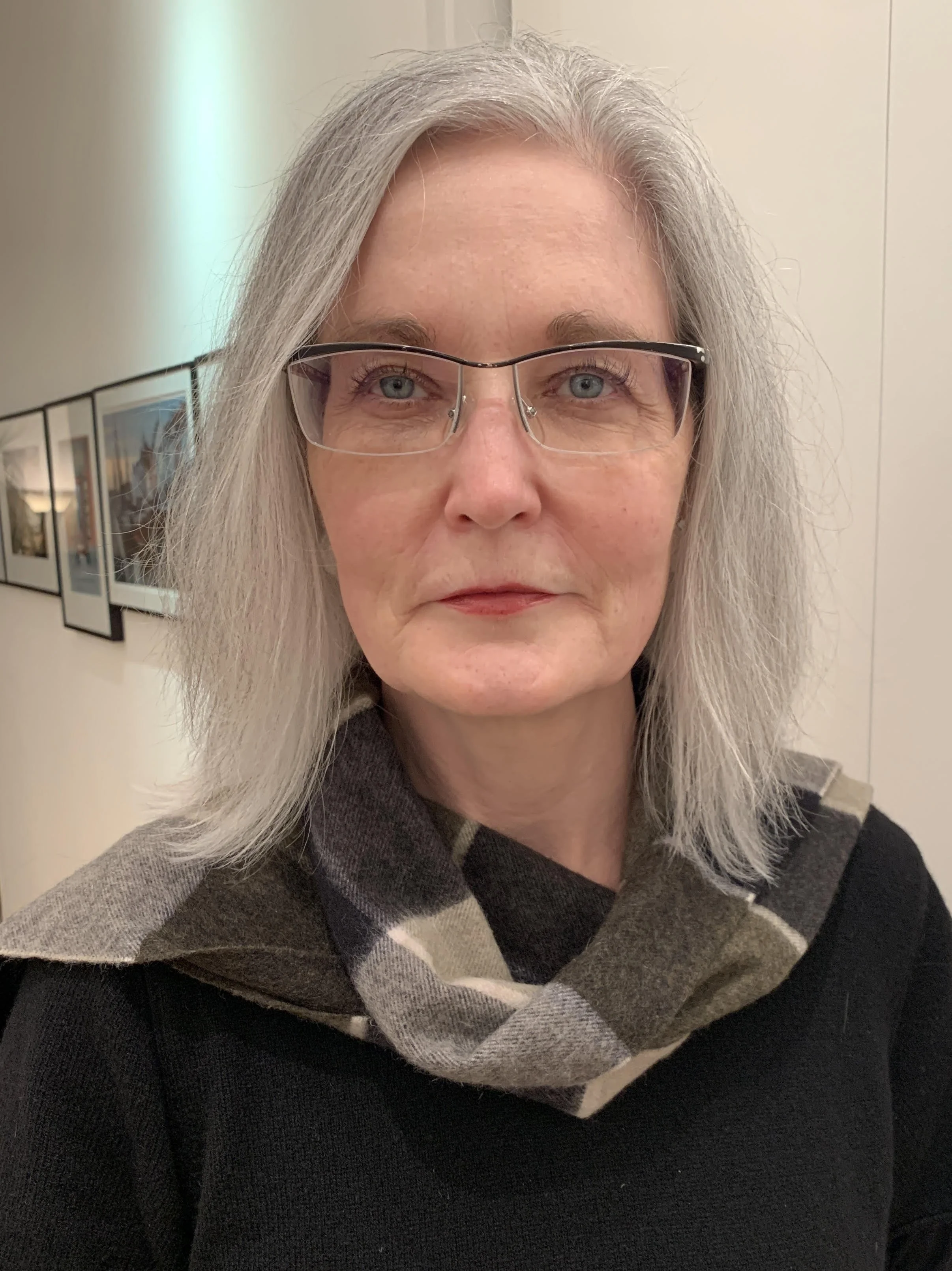
by Shaler McClure Wright

I’d like to thank Health Story Collaborative for working with me to bring you “Soul Chronicles for the Chronically Ill.” This monthly audio column offers a soulful perspective on navigating the unique challenges of living with ongoing health conditions. My name is Shaler McClure Wright and I’m a writer/artist living with Chronic Inflammatory Response Syndrome.

Have you ever wondered how you might describe your essence?

The part of you most connected to your soul?

Last month we considered Carl Jung’s belief that body and soul are not two things, they are one. With that in mind, our essence would also be the part of us most connected to our body. And for those of us with chronic illness, we’d be hard pressed to imagine anything with a stronger connection than that!

Let’s take a moment to imagine our illness as our essence…

Your first reaction is probably shock, or even horror. “What! I’m essentially ill?” 

So let’s try a softer approach. Let’s imagine that instead of spending our time and energy trying to ignore our discomforts, we shift and allow ourselves to see our chronic condition as a major, ongoing presence. After all, it’s as much a part of us as our heartbeat.

“Renaissance doctors believed the essence of each person originates as a star in the heavens,” says spiritual writer Thomas Moore in his book “Care of the Soul.”

To me, this means we have an inherent connection to something greater than ourselves, and our essence is shaped by that connection. And if our essence is chronic illness, then it, too, is connected to something greater than ourselves, with all the mystery that implies.

If we can imagine our illness having deeper meaning, then we can open to the possibility of discovering hidden aspects of our connection. Moore goes on to suggest a connection between our essence and our suffering—which we might visualize as a connection between our illness and our suffering:

“It is a beast, this thing that stirs in the core of our being, but it is also the star of our innermost nature. We have to care for this suffering with extreme reverence so that, in our fear and anger at the beast, we do not overlook the star.” - Thomas Moore, “Care of the Soul”

 I love Moore’s concept of approaching our suffering with reverence. It leads me to wonder how we might also approach our illness with reverence. How might that change our perspective? And what could there possibly be to revere?

I’d like to suggest that our relationship with our illness is likely the most important physical relationship we have. That may sound alarming, but for those of us with chronic conditions, before we can enjoy any other relationship, we need to accept, understand and maintain a committed relationship with our illness.

 Elizabeth Nelson, Jungian scholar and author, has developed a technique for recognizing our commitments and evaluating their meaning. To begin, she invites us to shift our focus from ego to soul.

Most of us, she says, sustain multiple important relationships—to people, projects, causes, and one’s self—that demand time and energy. She invites us to imagine each relationship as a metaphorical marriage, to give it the weight it deserves. Dr. Nelson believes “one must awaken to the possibility that we are trying to maintain several competing ‘marriages’ in life,” then asks, “which is your primary commitment?”

 For those of us with ongoing health conditions, our primary commitment needs to be to our health, even before our commitments to partner and family. This commitment, however, may be hiding in plain sight because we don’t want to think of illness as a companion who accompanies us through life.

 To explore the shadowy aspects of our relationship to chronic illness, we might give ourselves the exercise of writing a letter. Asking our illness what it wants and needs. Asking how we can honor our connection.

 In Jungian psychology this process is called active imagination. It’s ok not to know how to begin. Just clear your mind, breathe, and write down whatever comes up without judgment.

You may feel uncertain about writing to a chronic health condition rather than a person. You may feel without direction, but if you can allow your thoughts to wander, and remain open to the images that come to you, you’ll succeed.

Let’s begin by using a prompt for reflection:

‘If my illness is my essence, then my illness is both beast and star.’

How does that make you feel about your relationship?

I like to start by asking a stream of questions, until eventually one sticks, and without effort, another point of view begins to reveal itself.  I’ll show you what I mean by sharing a bit of my imaginary letter…


“Dear Illness,

I wonder how you feel, knowing you cause me to suffer?

I wonder if you consider yourself a beast?

I wonder how you could ever possibly be my innermost star?

My resistance to disease makes me want to run away from my body, but it makes you want to stay. I guess that makes you the fighter; the one who is not afraid to dirty her hands. And that makes you brave. 

I understand there’s more than one side to you. A beast is only a beast in the eyes of its beholder, and I don’t want to fear you any more. I want to touch your soft spots. I want to rub your belly at the end of the day when you stretch out in front of a fire.

But I don't have a sense of your size. How much space do you take up? Are you really as massive as I fear you to be? Perhaps you’re only as massive as my fear allows you to be.

I feel you thump in my chest. I hear you ringing in my ears. I sense you filling my mind with white fog. I see you drenching my clothing with sweat. You’re good at demanding my attention.

But you also inspire me—with your strength and resilience, your willingness to dance with the unknown, your comfort with change, and your refusal to surrender—even when we can’t see a path through the fog.

I can honor you for our differences. I’m grateful for our differences. Perhaps I am even better off for our differences. In a way, you complete me. You’re the part of me that never gives up.

If you are part beast, then the beast is the most animated part of you, but not the most effective. The beast feels trapped in my body and misunderstood and is crying out for attention. The beast in you is needy. 

But there is another, quieter part of you, looking ahead for opportunities to escape. Perhaps that is the star in you; focused on the possibility of illuminating a path in the dark.

I want to learn to see you in full—to see you as both beast and star—and I promise to hold you, my essence, just as a star holds the light of the moon.”


I hope you can see how writing this letter has revealed something new about my relationship with my illness. I now realize I want to deepen my connection, instead of trying to pretend it doesn’t exist. For all of us, illness has more than one dimension, and if we can learn to see it in full, then perhaps we can be more honest about our commitment.

“A good life is nourished by making wise commitments,” Dr. Nelson reminds us, “And ultimately, committing wisely is care of the soul.”

Go here for more episodes of our Soul Chronicles series.


Shaler McClure Wright is fascinated with the mysteries of creative process, the healing power of creativity, and the creative synthesis of method acting, intuitive learning and depth psychology. A graduate of Wesleyan University and The Actors Studio, Shaler has worked as an actor, writer and educator for more than 40 years, and lives in southeastern Connecticut with her husband and son.

Website: www.shalermcclurewright.com

Instagram: https://www.instagram.com/soulchronicles22/ , @soulchronicles22

FaceBook: https://www.facebook.com/profile.php?id=100012522457289


The Interconnection of Invisible Illness

By Laura Stepnicka

Invisible illnesses are all I know and have reshaped every fiber of my being. Many develop mental anguish after years of managing crippling chronic pain - but I went reverse course. 

In 2016, I was in a battle for my life. That battle was my own internal battle. I nearly did not survive. My mind was being ravaged by what would soon be diagnosed Major Depressive Disorder. The subtle signs had been running under the current for some time, but once depression truly took root, it would not relent. Depression ravaged my mind and distorted every single shred of reality. Of perception. Of clarity. 

 During the darkest depths of my battle with mental illness, the disease stole my strength, clarity, cognitive functioning, and ability to make even the simplest of decisions. I became a shell of a human. The previously super social creature I was became a mute. I withdrew from people I loved. I stopped being able to do my job. I stopped knowing how to live. The mind is so powerful and once illness invades, disease wants to be the victor.  

In the 3 years following 2016, there were entirely too many moments staring at my broken, defeated face in the mirror. It became a battle of self-will for survival. Fight for one more hour. And then one more.

Suddenly, the years have passed, and I am a survivor. I am strong. Resilient. Empathetic. I know the depths of finding yourself swimming under current, constantly attempting one second above water. The undercurrent is unpredictable. Especially when it seems that you have the heaviest weights strapped to your ankles, bringing you further away from air. One breath. Come up for air. Back underwater. I know the depths of the deepest, darkest hole and fought my way out. I was brought back down and tested many times.

I taught myself how to rebuild. The healing journey always starts within ourselves. I had numerous resources and support that gave me an advantage, but the real work is internal. The treatment options I explored and utilized knew no bounds. When medications were not working, I researched and tried alternative treatment options, at the guidance of my doctor. When my doctor no longer served me, I found new doctors. No rock was left unturned in my fight to live. 

Absolute sheer will and leaning into the right resources is what allowed me to very slowly start rebuilding. I was building back up from the ashes.

 My mental health journey changed me, for the better. I found my voice and my purpose. I found my footing by honoring the pain, but embracing the beautiful parts of me that I discovered along the journey. I sat in the pain. I fought the hardest of fights. I did the work.

The invisible scars of my battles are etched in every fiber of who I am, but they are what make me who I am today. I actively practice gratitude. I find and cultivate joy in the smallest ways.

Shortly after I started healing mentally; I experienced what would become a lifelong journey battling another invisible illness: chronic pain. 

 After navigating some of the most renowned hospital systems to help understand and treat my chronic pain - constantly shifting, pivoting and advocating for my care - I see how much those of us with invisible illnesses have to advocate to be taken seriously medical. Illnesses that cannot be seen require medical professionals to trust their patients. For women, symptoms that cannot be seen are entirely too often considered psychosomatic and in our heads.

 The onslaught of my chronic pain was similar to my diagnosis in 2016 with Major Depressive Disorder. Fast and furious.

I lifted my 30 pound nephew one day, who I had lifted often for the first 1.5 years of his life, and that was the beginning of my chronic pain journey. Pain arrived suddenly and never went away. Soon after that incident, after being turned away by a medical provider, the bulging disc hit a nerve cavity that has now compromised my right leg. I drive with my left foot. I often limp. I wear a specialty belt and have a lumbar pillow that comes with me everywhere I go. I wear compression socks and take two baths a day with essential oils and bath salts. Despite these efforts, the nerve damage spread to both hands and I developed carpal tunnel out of nowhere. It was at the stage of needing surgery. And then it healed. To me, this is a testament to the strength of cultivating a strong, resilient mind.

Nearly every single moment, awake or not, for the last 2 ½ years, I am in varying degrees of pain. It is difficult to get the care you need for illnesses that cannot be seen to the outward eye. Despite that, doctors have shared that my body is in overdrive trying to heal itself. I owe that to the strength and perseverance of my mind. The mind that turned against me and told me I was not enough. That same mind now works for me to help me fight my new invisible illness that will also be with me for life.  

The work I did to heal myself through my mental anguish, the ability to finally sit and feel the mental turmoil, allowed me to climb out of my personal purgatory. The strength of your mind is humbling. 

We all hold pain and uncertainty differently. We all find strength, resilience, fight our internal battle, differently.  I cannot tell you how many days I looked in the mirror, with puffy, swollen, defeated eyes and tears streaming down my face and literally, out loud, spoke to my reflection. I willed myself to keep fighting. To keep fighting. One more breath. One more moment. One more day. That was my life.  

And now, I have built a life that is beyond what I could have imagined. The person I was in those years of torment, is never far, but she grounds me. She reminds me to be grateful. To appreciate the small, simple moments. To persevere. She is also always in physical pain, but people do not believe what they cannot see.


Laura Stepnicka is a Chicago native who lives with two invisible illnesses: depression and chronic pain. These invisible illnesses have changed every fiber of her being and she is very aware that her conditions are part of a lifelong journey of healing and growth. A journey she has fully embraced. Laura decided in early 2021 to make several lifestyle changes and moved to a one stoplight kind of town in Southwest Michigan, nestled in her log cabin in the trees with her sweetest foster fail, Piper. More on her blog, Cocoon for the Kindred.


Laura