
When Force Stops Working
By Sarah Whaley
On May 20, 2025, I walked into a gym and joined on the spot. It had been more than a decade since I had exercised with any real consistency. I was overweight, chronically tired, and physically weaker than I wanted to admit. For years I had shown up for work, for family, for responsibilities that were legitimate and often urgent. I was reliable, productive and effective. What I had not been was intentional about myself.
So I began going to the gym five days a week. This was not a casual endeavor. I treated it as a non-negotiable commitment, something sacred just for myself, a place where no one needed anything from me and I could show up solely for myself. I rebuilt strength and stamina the way I had built everything else in my life: through discipline, repetition, and a willingness to push.
By September, I had lost more than 20 pounds. My shoulders, biceps, and quads were defined. My endurance was measurable. I was swimming over a hundred laps simply because I could. I felt capable in my body again. This was not decorative, but functional strength.
In October, I was diagnosed with cancer.
The obvious fears surfaced: mortality, uncertainty, loss of control. Underneath them was a more immediate frustration. I had just fought my way back into my body. I did not want to lose it again. Cancer was an inconvenience. It impeded all the progress I had just made.
People told me that being in good shape would help my recovery. They were right. But what they meant as reassurance felt, to me, like a consolation prize. I did not want to be strong going into cancer. I wanted the life that did not include cancer at all.
Surgery set me back. I lost muscle mass and conditioning. Four weeks post-op, I returned to the gym. In retrospect, it may have been too soon. I was careful, but I was also propelled by an instinct that has governed much of my adult life: when confronted with disruption, apply force. Force has served me well. I have spent much of my life sprinting—academically, professionally, personally—and the sprint has produced results.
Society rewards acceleration. We admire those who push through fatigue, who refuse to yield, who equate motion with strength. Restraint, by contrast, is often interpreted as hesitation or weakness. Leadership, in the cultural imagination, looks decisive and kinetic. I absorbed that lesson early. Strength meant exertion and progress meant pressure.
When complications developed and a second surgery became necessary—just as I had clawed my way back to roughly ninety percent of my prior conditioning—I confronted an uncomfortable truth: the very strategy that had built my success was ill-suited to healing. The impulse to accelerate, to regain lost ground quickly, to treat recovery as a problem to be solved through effort, was not only ineffective; it was counterproductive.
The first time I faced that setback, I panicked about losing progress. The second time, something shifted. I knew I could rebuild because I had already done it. The evidence existed. Strength was no longer hypothetical. That realization created space for a different distinction, one I had not previously needed to make. Control and agency are not the same thing. Control is the belief that outcomes bend to pressure. It privileges force, speed, and visible exertion. It works beautifully in environments where output correlates with effort. Many high-achieving people build their identities around control because it produces tangible rewards.
Agency is quieter. It is not the insistence on exertion but the capacity to choose the appropriate response to a given reality. Sometimes that response is force. Sometimes it is restraint. Agency does not confuse motion with progress.
Healing, I learned, does not respond to force. Tissue recovers at a biological pace. Inflammation subsides on its own timetable. The body cannot be negotiated with or intimidated. The sprint, so effective in other domains of my life, nearly sabotaged my recovery.
After the second surgery, my priorities shifted. I returned to the gym under significant restrictions. Initially, no lifting anything over ten pounds, no movement above ninety degrees, no swimming, and reduced reps. I was limited to mostly walking and light cardio. The swimming I love would have to wait. The strength training that makes me feel grounded would have to wait. For perhaps the first time in my adult life, I am not treating delay as failure.
There is a particular discipline in patience. It requires tolerating unfinishedness. It requires trusting that capacity can be rebuilt without rushing the process. It demands a kind of leadership over oneself that looks, from the outside, less impressive than relentless drive.
We live in a culture that valorizes sprinting. Those who succeed through grit and determination often struggle to recognize when force is no longer the optimal strategy, because force has been the engine of their identity. We are trained to override fatigue, to compress timelines, to treat limits as negotiable. That approach builds companies, careers, and reputations. It does not necessarily build sustainable health.
In a single year, I have been both the sickest and, in many ways, the healthiest I have been in over a decade. I am down more than forty pounds since that random day in May. I have endured surgeries and setbacks. I have also learned that strength is not synonymous with acceleration.
I will lift again. I will swim again. I will rebuild again. But right now, healing is the work. And the most disciplined choice I can make is not to sprint.
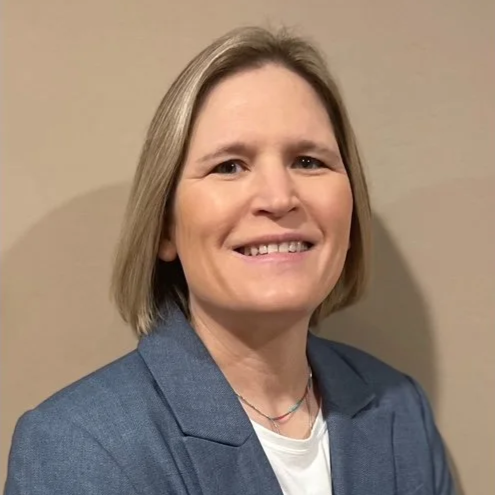
About the Author
Sarah Whaley is a school district administrator who examines systems at the intersection of leadership, health and human behavior. Her work explores the tension between force and agency, and how the traits that drive achievement can both build effective systems and, at times, undermine them