
Sustaining through ALS with Love
By Martha Eichler
In the fall of 2022, my husband Rob was “counting the days” until his retirement in June of 2023 at age 70. His career was in health care information technology, but he had a former life as an actor, director, and stage manager in the theatre. He played Truffaldino in The Servant of 2 masters, Tusenbach in Three Sisters, Mr. DePinna in You Can’t take it With You, and many other characters. He also worked as a stage manager and director in other productions, such as A Midsummer Night’s Dream, and Free to Be You and Me with hearing-impaired youth, which prompted him to learn and become fluent in American Sign Language. Eventually, he parlayed his dramatic talents and organizational skills into a career as a management consultant in Health Care I.T. I think he was playing a new character in the business world. His love for theatre took a back seat to a more secure financial future in the corporate sector to support our family, which includes Caroline, now 36, and Tory, now 28.
We were happily imagining some post-retirement travel, more time to do fun things, and Rob was planning to get back into theater in some capacity. He had already begun dabbling in dramatic pursuits. Rob and I had also designed and run a storytelling series with local folks in Peterborough, NH, we called the Black Fly Story Hour. But that fall, Rob began experiencing a lot of coughing and mysterious swallowing issues. At first, they seemed minor, but they were annoying and worrisome to both of us. He also seemed to be having some trouble getting up off the couch. The symptoms were so disjointed that I was at a loss to connect the dots. In November, Rob did a recitation of an excerpt from the Dylan Thomas play, Under Milkwood, at a public presentation. He did a masterful job, but it looked somewhat arduous for him. I think this was the first hint that his voice was starting to change. He seemed slightly breathless. I had a vague premonition that something was wrong.
In December, Rob’s speech started slowing down. I watched anxiously as he tried to convince our younger daughter that she had to add oil to her car before driving it: It was a fraught exchange. The slowness was subtle, but definite. I had also begun to witness, over many prior months, brief crying jags at inappropriate or illogical times—like watching a sappy commercial on TV. Rob often did public speaking at our UU Church. The minister asked him to do a Wendell Berry reading one Sunday, and he got visibly, emotionally overwrought while delivering it. The constellation of symptoms was mystifying, and scary. At a certain point, even at this early stage, unbeknownst to each other until much later, my daughter Caroline and I both had a terrible gut feeling that it might be ALS. And my consultations with Dr. Google started to elevate this prospect. Then began a series of doctors’ appointments, first with his PCP, and then with a first-year neurology resident at a large medical facility. After several tests, there was still no definitive diagnosis. Meanwhile, Rob’s speech kept slowing, and slurring. Co-workers began to notice.
I threw a retirement party for Rob on July 1, 2023. It was a beautiful event at an art gallery. Our daughters and many friends and family came from afar. Aside from his slightly noticeable slurred speech, he looked fit and healthy, and handsome! Rob told the guests that he was dealing with a speech issue. It was a joyful celebration. Amidst the art, I had hung a 2-foot square black and white photo of Rob holding and reading a book, his feet on the handlebars, while riding a moving bike down a leafy path at college. In the photo, he looks invincible and carefree. But fate was now about to twist him down a perilous path.
Two days later, we had a Zoom appointment with the neurology resident. I asked if Rob should have a test for Lyme Disease. The resident said she didn’t know and wanted to call in her attending physician. He entered the Zoom. He was not an ALS specialist. I repeated my question to him. He said, “No, I don’t think that’s necessary. Anyway, it’s probably ALS.”
It was like a bomb detonated. Rob and I were standing in front of a laptop screen. It felt like we dropped off a precipice into a black hole. The two physicians then recommended that Rob make an appointment with the facility’s ALS specialist, but when Rob called the next day, the first available appointment was in April 2024. The following year!! We were incredulous that we would have to wait 10 months to get clarification on this illness. At that point, we ended our affiliation with that medical facility. Then we found Mass General. But for 2 months, we worried and waited for help with this unknown affliction. Rob was diagnosed on our first visit there, on August 29, 2023. It was soul-crushing. Getting a diagnosis of a terminal disease is like no other news. Rob’s ALS doctor at Mass General was as kind and sensitive as anyone could be delivering this verdict. But it was traumatic to hear. Rob crumpled into fear, sadness, and some rage. He wailed with despair. I stood by, helpless and in shock, but trying to be supportive. It felt other-worldly. His lifespan was uncertain—likely 3 to 5 years.
We had driven up from a beach rental in Little Compton, Rhode Island, to this appointment. Our daughter Caroline and her husband Alex were in Boston with us. Afterwards, we clawed our way through rush-hour traffic back to Rhode Island and tried to process all of this. Back at the cottage, a 1000-piece jigsaw puzzle was a welcome distraction—piles of little pieces of a floral design, hardly distinguishable from each other, but each with a place they would ultimately fit, completing the picture. We had a deck with a beautiful view of the ocean in our backyard, which helped. And an army of surfers to watch as they enjoyed huge waves from a distant hurricane. We were engulfed in choppy waters both literally and figuratively. Rob had been advised to take three ALS medications to slow the disease. One drug cost $14 thousand dollars a month, which would bankrupt us. We had to do extensive research to figure out how to pay for these meds with insurance and charitable foundations.
We set up a Caring Bridge site, which has been a useful and creative outlet for essays by both Rob and me. Friends and family from everywhere could learn about Rob’s diagnosis and offer support on the site. Rob has even made humorous videos and posted music. The heartwarming feedback from our readers has helped sustain us in the worst of times.
By the spring of 2024, life was still sort of normal for us. Externally, Rob looked fine. and his functionality remained high. He could still eat, drink, take pills, drive a car, and speak, though with difficulty. My involvement was mostly as a companion to navigate the uncertainty of both the present and the future. While not yet physically caregiving, I was riding this emotional roller coaster with Rob.
We decided to take a month-long train trip from Chicago where our daughter and her husband live, to New Mexico, California, and then up the west coast to Oregon and then Washington, with many stops along the way to see friends and family. We returned to Chicago on the train, a 2-day trip that passed by spectacular views of majestic snow-capped peaks and sparkling blue and green rivers through the wilderness of Glacier National Park. Then we flew home. We discovered that rail travel is not for the faint of heart, as we carted luggage around huge train stations and endured the no frills sleeping quarters. Still, we loved this journey.
As Rob lost his ability to speak, he started reverting to American Sign Language. Our daughter Caroline began to learn it with an online APP. This became a means of communication for them. The prior fall, he had also been working with a wonderful Speech and Language pathologist to record over 500 phrases with his own voice. Phonemes are drawn from his recordings to run a speech APP on his cellphone, so he can communicate in his own voice. It was slightly eerie but also magical to hear Rob speak through this technological marvel. Sometimes his voice is robotic, or barks commands, but mostly it is comforting to still hear Rob.
Summer 2024 brought more challenges. I had a bout with invasive squamous cell carcinoma on my left nostril that required a 5-hour MOHS surgery and reconstruction in July, then a month of daily radiation from August to September. Previously in my life, I had survived ovarian and colon cancers, and Cutaneous T-Cell Lymphoma, a minor skin cancer. Rob had been my caregiver, and now I was his. His care and lovingkindness had seen me through, and now I was striving to do the same for him. But dealing with yet another cancer as Rob’s condition worsened was very stressful. At the same time, much of our house was torn apart for close to 9 months for asbestos and water remediation, and reconstruction, due to a leak in an upstairs bedroom. In November, Rob stopped driving; he also went to Mass General for surgical implantation of a G-tube. He was no longer able to eat solid food. I had been pureeing meals for him in a blender for several months prior to the procedure—an onerous, messy task. Spaghetti, chicken, broccoli, gnocchi– I learned that anything can be turned to mush with enough propulsion! Then began the more hands-on aspects of caregiving. Soon, nearly all of Rob’s nutrition would come from liquid formula that I would administer directly into his belly through the G-Tube.
As we entered 2025, Rob’s right arm and hand—the dominant one—became non-functional. I had to learn how to use the G-tube and syringes and take care of the surgical site. In March, Rob began to have difficulty going up and downstairs from our bedroom. That meant buying a bed and setting up our TV room for him as a bedroom. I had to rearrange the room and store some of the furniture elsewhere. A storage pod came to live on our driveway. Rob started to use a rollator to walk. Fatigue started to impact Rob’s daily life, and mine. We increased his use of a ventilator machine to enhance breathing, a suction machine to deal with ever-present saliva (we call this one “Mr. Thirsty”), and a cough-assist machine. We also now run an air purifier and a humidifier in Rob’s room. Buzzing and whirring noises often permeate the air. All these machines require cleaning and maintenance. By summer, a hospital bed was deemed necessary. The bed we bought in April was now obsolete. The heat of the summer was oppressive, so we had to install an air conditioner in his room. I was now darting from room to room to grab Mr. Thirsty and the cough-assist machine many times a day, and this continues now, often in the middle of the night. As the summer progressed, Rob’s mobility declined. He was outfitted for a huge, motorized Permobil wheelchair in June, which I named the Big Kahuna, and we also obtained a smaller, transportable wheelchair. Stuff was everywhere—and still is. As a person who struggles with organizing things, this chaotic situation has brought me great anxiety and frustration. As the fall of 2025 progressed, the hospital bed became very uncomfortable for Rob and getting him on and off it became impossibly difficult. He decided he wanted to sleep in the Big Kahuna. He essentially lives in this chair now.
Today, Rob’s care includes all personal hygiene, administration of formula and medications by G-Tube, all transfers and transitions—everything except use of his cellphone which he does with maximum effort for texts and the Voice APP. He keeps a washcloth in his mouth 24/7 to absorb the excessive saliva. Rob jokingly calls ALS “A Lotta Saliva.” The cloths get saturated quickly and need to be replaced several times an hour. Often, they drop out of his mouth, and he can no longer place them in his mouth himself, so I fetch them and insert them for him. Getting him to a doctor’s appointment is now impossible for me to do alone, as I cannot get him in and out of my car. I found and hired 2 wonderful caregivers in the fall—no easy task--who have been a godsend. But care is expensive and so the bulk of the care still falls on me.
Some of the hardest things for me are living with a non-speaking partner, whose technological communications are laborious and slow, and whose plaintive non-verbal vocalizations I don’t always understand; and the daily grind of caring for a loved one who can do almost nothing for himself and requires near-constant attention and interventions. I rarely cook anymore, a former passion of mine: there’s no time. There are no dinners out or sojourns anywhere. The days revolve around medication schedules and naps. Our days start upon waking, and I don’t go to bed until after midnight. My time is fractured by mad dashes for breathing machines or washcloths or eye cleansers or circulatory booties, or to do laundry or add water to the humidifier. It feels like the movie “Groundhog Day,” except the scenario of each new day cannot be tweaked for improvement. I can’t invent a new, better reality each day. All of my interests and aspirations are on hold. I have a sense of foreboding that the difficulties are only getting larger.
Because ALS is a degenerative disease, it involves constant change. The symptoms evolve and multiply. What worked yesterday, doesn’t work today. I don’t like change.
I have had to grow a hard shell—to cope with unrelenting demands, and deal with whatever comes our way. I worry that my armor is reducing my ability to empathize. Am I kind enough to my poor husband? Patience wears thin as I grab for washcloths all day long and stuff them into Rob’s mouth, or run to bring Mr. Thirsty or the cough machine, or tear down the stairs in the middle of the night at the sound of Rob’s beeper, to help him one way or another. How do I keep my cool and remain gracious and kind when I am taxed to the max?
I love my husband, but I hate this disease.
But there are bright spots: Friends and family who offer love, support, food, and the gift of their presence and understanding. Caring doctors, nurses, and therapists. A neighbor I barely know came to my rescue getting Rob in and out of my car for a doctor’s appointment. He also tuned up and repaired a generator as a blizzard was blowing in. My church has set up a Meal Train and I get lovely meals delivered by culinary Good Samaritans at least once a week. The outpouring of kindness and empathy and concern has been immensely supportive. I have taken to calling these amazing people “earth angels.”
Our daughters come as often as they can to help, with utmost kindness and resourcefulness. Our family cannot escape the sadness that accompanies the unstoppable diagnosis of ALS, but together we can still laugh and have good times. Rob maintains a good sense of humor and equanimity. He is amazing.
One of my greatest worries is for my own health, considering my health history. Caring for Rob is not optional; it is a necessity. I have lost weight and sleep on this odyssey. I try to trust my body, and hope that it will see me through this ordeal, that it will be reliable. I tell myself I can do this. One of my biggest challenges is always being the host, the translator for Rob, whose communications are slow. Social visits are vital to our mental health and happiness, but this involves housekeeping – not my strong suit. Nor do I have much time for it. I try to accept that social connection is more important than a tidy house. As I was preparing this presentation, I was still enjoying my tiny Christmas tree in March!
It is an unanswerable question, but I wonder why the blow of a disastrous disease has been dealt to such a gentle, good man. How do we make sense of this or any tragedy? A friend asked if Rob and I have a spiritual anchor to keep us afloat in this time of crisis. Rob follows the Tao te Ching, and manages to stay even keeled, guided by this ancient wisdom. As for me: not so much. I am completely harried by the physical exhaustion and mental anguish. As I told my friend, in this struggle with ALS, for me, survival obscures the spiritual. But Rob inspires me to find the way forward. Love keeps me going.
About the Author:
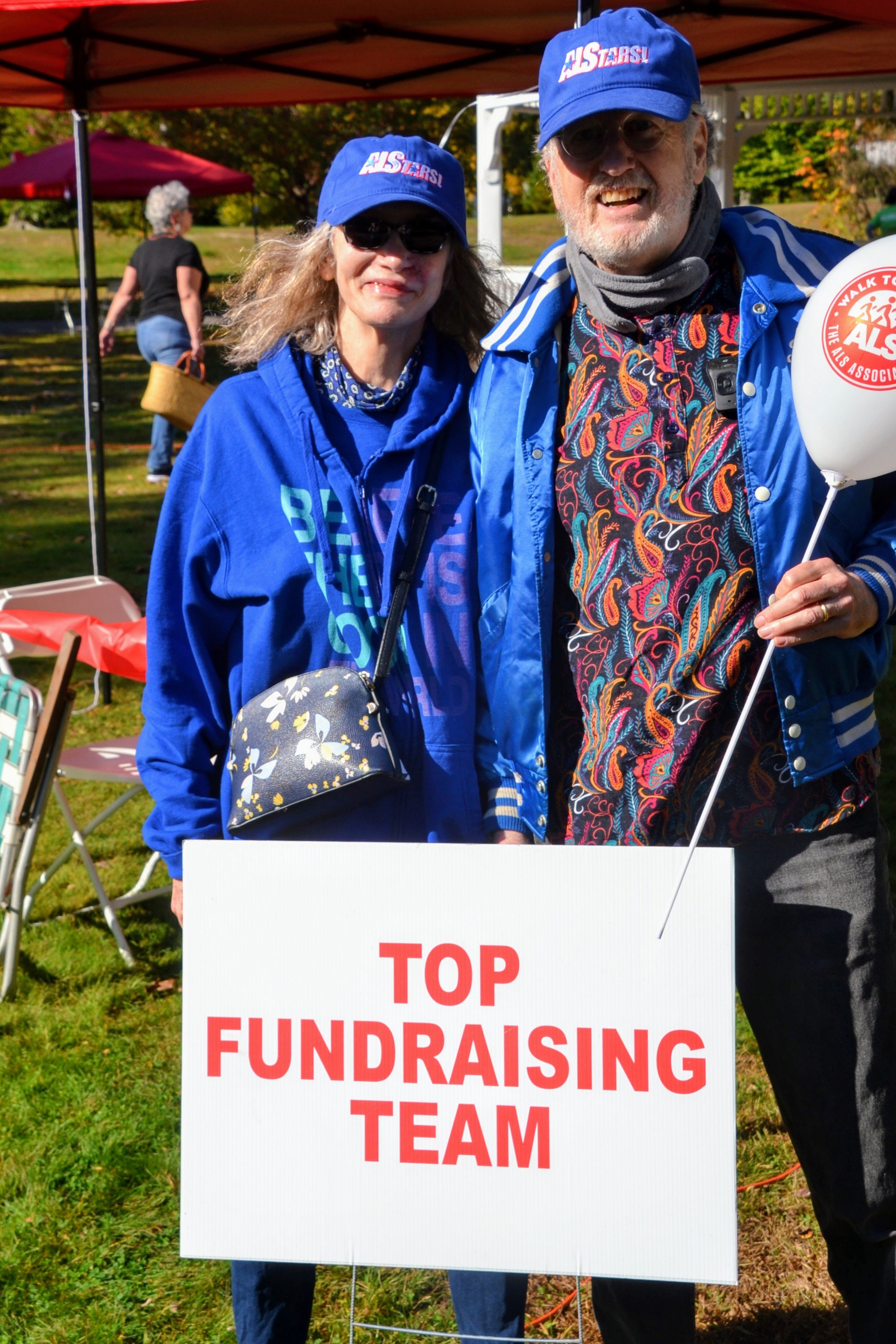
Martha Eichler is a caregiver for her husband, Rob Eichler, who was diagnosed with ALS in 2023. They reside in Peterborough, NH, where they raised their daughters, Caroline and Tory. Martha herself has been a patient, diagnosed with ovarian cancer in 2002, and three other cancers over the years, including colon cancer in 2020, at the height of the pandemic. Through all of these trials, Rob was her caregiver. With illness as a recurring backdrop in her life, Martha has sought methods to process and live through its challenges--first as patient, now as caregiver for Rob.