
The Healing Through Wonder Project: How Awe and Wonder Help Us Live with Uncertainty
By Val Walker
Muddled by heavy thinking about national and global events alongside my own troubles, I’m overloaded, distracted, and cannot stop doomscrolling. How dare I step away from my laptop and phone just to sit by the window?
Yes, just sit there.
I gaze upon sparkling snow-laden trees and blue sky with soaring grey and white clouds. A burst of wind sprays powdery snow from the waving limbs of these amazingly agile trees, and it takes my breath away. A bold chickadee darts through the freezing, lingering breezes and alights effortlessly on a lower branch near my window. We are close enough for eye-to-eye contact. We see each other and pause. Time stops.
Enchanted, I lose myself in the moment and my thoughts disappear. I needed this moment, this chickadee visit, these spiraling ribbons of snow drifting from the treetops. How beautiful and perfect this all is!
I’m awestruck and dumbstruck at once. And it feels good, right down to my bones, just to know that my sense of wonder has allowed me to welcome the blessings of a January afternoon in New England.
Thank goodness for our human emotions of wonder and awe!
Here in this moment, in this wonder, is where I belong, no matter how awful the ever-breaking news makes me feel.
I can be astonished by the wondrous beauty around me, yet at the very same minute, still feel anguish, outrage, and grief. I behold the opposite poles of my emotions: the awe of a chickadee, trees, sky, and snow, and the heartbreak of ruptured alliances between nations, a crumbling world order, turmoil in Minneapolis, and closer to home, the death of a dear friend last month.
This mix of widely divergent emotions echoes the fluid state of our sense of security in our lives and in our world at these times. But fortunately, even brief pockets of wonder give us steadiness, grounding, and a sense of belonging to the oneness of the moment. Having faith in the power of these moments of awe might help us live a little easier through uncertainty and erratic changes.
Indeed, I am in awe of how we as human beings can stop and marvel at something wondrous that takes our breath away while still in the throes of grief or crisis—all in the same day. Our ability and willingness to be amazed make us resilient and hopeful.
In my new book, Healing Through Wonder: How Awe Restores Us After Trauma and Loss, I profiled people who were exceptionally open to experiences of awe, wonder, and beauty. Their awe-inspiring encounters with amazing people, places, nature, and the arts gave them hope and meaning, even in times of overwhelming grief and turmoil.
I would like to share the well-earned wisdom from three people profiled about how awe and wonder can help us live in uncertain and turbulent times.
Robyn Houston-Bean
Robyn is the founder of the Sun Will Rise Foundation, a nonprofit organization dedicated to grief support for people who are bereaved due to substance-use-related causes. Her foundation was created after her twenty-year-old son, Nicholas Bean, died from an accidental polysubstance overdose in May 2015.
Robyn’s Wonder Wisdom
“How do we lose our sense of wonder? People lose their sense of wonder when they lose hope. They don’t look forward to anything.”
“What helps us heal through wonder: Appreciate the little wonders, the little surprises, see the beauty around you.”
“Notice the concrete, physical things, the things you can touch (to ground yourself). Take a walk. Listen to the wind.”
“Be willing to share your story of a wondrous thing (it might inspire someone else).”
“We need a sense of wonder to keep us connected to the world outside of ourselves. If we don’t have wonder, we think we are all alone, and our pain is ours alone—and that makes us lonely.”
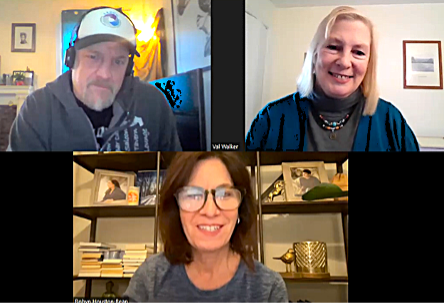
Luke Schmaltz (upper left), Val Walker (upper right), Robyn Houston-Bean (lower center) share stories of wondrous encounters on the Healing Through Wonder YouTube channel.
Luke Schmaltz
Luke is a songwriter, singer, writer, and an advocate for trauma survivors and others in recovery. He lives in Denver, Colorado, and writes for the VOICES Newsletter for SADOD (Support After a Death by Overdose).
Luke’s Wonder Wisdom
“What causes people to lose their sense of wonder? Isolation, avoiding conversation and interactions. Being too caught up in your headspace. Not noticing a sense of connection in nature and animals.”
“Wonder helps you by shifting your focus to something or someone outside of yourself.”
“Finding wonder happens in everyday conversations. Being grateful for the amazing things people say and do.”
“Wonder restores our faith in humanity and makes us more compassionate.”
“Wonder keeps us from relying too much on technology.”
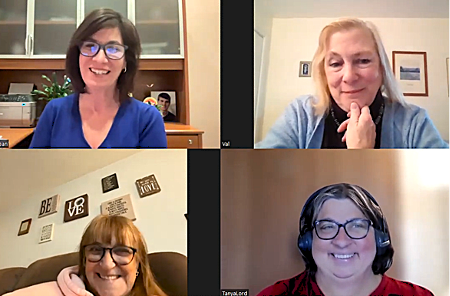
Robyn Houston-Bean (upper left), Val Walker (upper right), Carol Bowers (lower left), Tanya Lord (lower right) share stories on the Healing Through Wonder YouTube channel.
Carol Bowers
Carol volunteers with local recovery and peer grief support organizations in the greater Boston area. She is the proud mother of a daughter and son, with five grandchildren and two great-grandchildren. Her husband, Jeff, died in 2022 after a strong, loving partnership of thirty-one years.
Carol’s Wonder Wisdom
“What causes people to lose their sense of wonder? Society can be harsh and judgmental.
“Social pressure to fit in can push us away from our sense of wonder.”
“How wonder helps us live with grief: Sharing our stories of wonder with each other and talking to people who have been through what you have.”
“We can inspire wonder in each other by showing interest.”
“Wonder helps us stay authentic in a world of social pressure to be someone else.”
“Wonder helps us be honest with each other.”
“Wonder is everywhere if you are willing to see it.”
“My favorite song is ‘Hold on for one more day’ by Wilson Phillips.”

About the Author
Val Walker is a contributing blogger for Psychology Today and the author of The Art of Comforting, a Nautilus Book Award Gold winner that was recommended by the Boston Public Health Commission as a guide for families after the Boston Marathon bombing. She is also the author of 400 Friends and No One to Call: Breaking Through Isolation and Building Community and speaks nationwide on building social support after loss and major life changes. Val is a former rehabilitation counselor who now facilitates groups and workshops for people living with grief, illness, and disability. Her articles, quotes, and Q&As have appeared in TIME, AARP Online, The New York Times, The Wall Street Journal, Coping with Cancer Magazine, The Boston Globe, Caregiver Solutions, Good Housekeeping, and Chicago Tribune.
Her latest book, Healing Through Wonder: How Awe Restores Us After Trauma and Loss, was released January 8 with Bloomsbury Publishing.
Read more at https://HealingThroughWonder.com
Keep up with Val at https://ValWalkerAuthor.com
Visit the Healing Through Wonder YouTube channel. https://www.youtube.com/@WonderforLiving